

| Factor | 3D Printing | Injection Molding |
|---|---|---|
| 🏭 Mold Cost | ✅ Low · No tooling required | ⚠️ High (3,000–3,000–57,000+) |
| ⏱️ Production Lead Time | ✅ Short · No mold manufacturing needed | ⏳ Long (4-8 weeks for mold) |
| 🔄 Design Flexibility | ✅ High · Easy iteration | ⚠️ Low · High cost for mold changes |
| ✨ Surface Quality | 🟡 Moderate · Requires post-processing | ✅ High · Standard is good |
| 🧪 Material Selection | 🔢 Limited | ✅ Extensive · Standard & Engineering plastics |
| 💪 Strength/Reliability | 🔻 Lower · Anisotropy concerns | ✅ High · Superior mechanical strength |
The Real Differences Between 3D Printing and Injection Molding
How Their Working Principles Differ
If you go with injection molding, you’ll need custom metal molds to start production.
A full production-grade metal mold usually costs between $10,000 and $50,000, and it takes around 5 to 7 weeks to finish all mold development work. Once completed, these molds can reliably produce hundreds of thousands, or even millions of parts over their lifespan.
One huge advantage of 3D printing is that it doesn’t require any molds at all. The cost per piece hardly goes up or down based on order quantity, which makes it a perfect fit for small-batch runs, as well as parts with complex geometric structures that are hard to make with traditional methods.
As a mainstream additive manufacturing method, 3D printing gives designers nearly unlimited creative freedom. Even so, it still has quite a few performance limitations in real-world applications.
Differences in Structural Strength
Anisotropy: 3D Printing’s Most Obvious Weak Spot
Putting it in simple terms, anisotropy means a 3D printed part doesn’t hold up equally well when stressed from different angles and directions.
Injection molded parts are made as one solid piece. Their mechanical performance stays balanced in almost every direction, showing near-isotropic behavior.
On the flip side, 3D printed parts are weakest along the Z-axis, the direction vertical to the printed layers. Cracks and breaks most often happen right along those layer bonding lines.
Take regular FDM printed parts as an example. Layers bond together through filament molecular diffusion, melt adhesion, and mechanical interlocking. The bonding strength between layers typically only reaches 30% to 60% of the tensile strength of the printing filament itself.
Injection molded parts come out as dense, solid monolithic structures, so their mechanical performance barely changes across different directions.
Strength Showdown: Real Test Data You Can Reference
Case 1: ABS Material Performance Test
Most people in the industry naturally assume injection molded parts are always stronger than 3D printed ones.
But a detailed academic study focused on ABS thermoplastic materials has proven something quite different.
When researchers tested larger samples at 4mm×10mm, 3D printed parts only delivered less than 60% of the mechanical strength of injection molded ABS parts.
Yet things shifted completely when sample size was reduced to 2mm×4mm —
The tensile strength of 3D printed samples actually hit 110% compared to injection molded equivalents.
The reason is straightforward. For small-sized parts, the outer wall layers take up most of the cross-section area. These outer walls are denser and stronger than the internal infill structure inside the part.
The research also pointed out that simply increasing perimeter wall layers from 3 up to 11 can boost overall part strength, lifting it from under 60% to nearly 97% of standard injection molded ABS parts.
Case 2: How Printing Angle Changes Mechanical Performance
A dedicated comparative study tested how ABS-M30 performs mechanically under various printing angles.
The test clearly showed parts printed at a 45° angle achieved the best results in both tensile strength and impact resistance.
When it comes to flexural strength:
Parts printed with a T16 nozzle at a 90° orientation peaked at 67.18MPa, while T12 nozzle parts at the same 90° angle reached 65.43MPa.
High-performance engineering plastics like PPSF and Ultem 9085 hit 113.18MPa and 128.41MPa respectively in flexural strength when printed at 90°.
For impact strength, ABS-M30, PPSF and Ultem 9085 all reached their maximum limits at a 45° printing angle, scoring 45.56 kJ/m², 89.97 kJ/m² and 111.28 kJ/m² in order.
It’s worth noting that parts made by traditional injection molding still have slightly better impact strength than 3D printed versions using the exact same material.
Case 3: How Printing Orientation Greatly Affects PLA & PETG Strength
Following the strict testing standards ASTM D3039 and ASTM D3518, researchers ran controlled tests on two widely used FDM materials: PLA and PETG.
They wanted to see how printing direction changes their overall strength, and two clear patterns stood out:
PLA offers 21.1% higher maximum tensile strength than PETG at a 0° printing orientation.
At 90° and ±45°, PETG takes the lead, outperforming PLA by 13.7% and 12.3% respectively.
This clearly tells us different materials react differently to printing angles. Picking the right material plays a huge role in how strong your final printed part will be.
Injection Molding Vs. 3D Printing: Which One to Choose? It All Depends on Production Volume
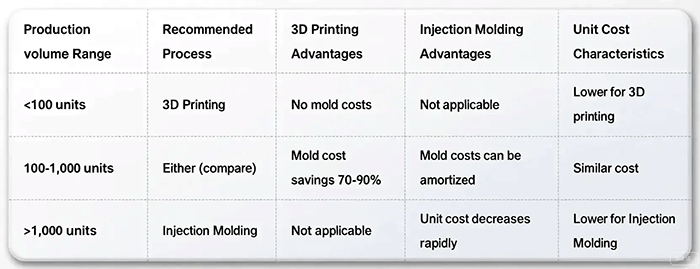
Scenario 1: Fewer than 100 parts
Go with 3D printing without hesitation.
You skip expensive mold costs entirely, can update and iterate designs fast, and it’s far more budget-friendly than building a brand-new injection mold.
Scenario 2: 100 to 1000 parts
You have two solid options: use 3D printed rapid molds for injection molding, or print parts directly with a 3D printer.
3D printed rapid molds cut mold development costs by 70% to 90% compared to traditional metal molds, though they don’t last as many production runs.
Direct 3D printing skips mold making altogether, gets your parts ready faster, but the unit price will be a bit higher.
Scenario 3: More than 1000 parts
Injection molding is the clear winner here.
Even though upfront mold costs are high, the cost per unit drops drastically when spread over mass production. Based on real industry case data, injection molded parts can cost over 85% less per piece than 3D printed alternatives.
For structural components that demand strict material quality and high load-bearing performance — such as automotive parts and medical load-bearing components — manufacturers mostly rely on injection molding.
On the other hand, 3D printing works perfectly for prototype testing, custom one-off parts, and components with complex internal cavities that are tough to machine normally.
At the end of the day, you can’t choose a manufacturing process based only on quantity. You also need to factor in strength requirements, production timeline, material type, and surface finish quality.
In real manufacturing workflows, these two technologies often work side by side.
Teams use 3D printing to iterate designs quickly, test prototypes, and even make rapid molds. Then injection molding takes over for large-scale mass production.
They complement each other perfectly, and this combination has become one of the most practical solutions in modern manufacturing.