

Ir al contenido
  • Testimonios
  • Visita a la fábrica
  • Spanish
    • English
    • Japanese
    • French
    • German
    • Italian
    • Spanish
    • Swedish
    • Irish
    • Dutch
    • Portuguese
    • Korean
    • Greek
    • Turkish
    • Vietnamese
    • Thai
    • Indonesian
    • Malay
    • Danish
    • Finnish
    • Hindi
    • Hebrew
    • Icelandic
    • Romanian
    • Russian
Nuevo logotipo de DT 3D Printing

Servicio de impresión 3D de DT

Fabricante OEM – SLM (Impresión 3D en metal) Especialistas

  • Inicio
  • 3Servicio de impresión D
    • SLM (Fusión selectiva por láser)
    • SLA (Estereolitografía)
    • SLS (Sinterización selectiva por láser)
    • DLP (Procesamiento digital de la luz)
    • FDM (Modelado por deposición fundida)
    • MJF (Multi Jet Fusion)
    • BJ (Inyección de resina)
  • Mecanizado CNC
    • Torneado CNC
    • Fresado CNC
    • Postprocesamiento
  • Guía de materiales
        • Materiales plásticos para impresión 3D
          • Resina (ABS-Like, Estilo PC)
          • Nylon (PA6, PA12, TPU)
          • Red Wax
          • PLA, TPU, PA, Fibra de carbono, PC
        • Materiales de impresión 3D en metal
          • Aleación de aluminio (6061 / AlSi10Mg / 7075)
          • Acero inoxidable (316L / 304L / 17-4 / 347)
          • Aleación de titanio (TC4 / TA1)
          • Mold Steel (S136/HB/CX/1.2709)
          • Aleación rica en níquel (GH4169 / GH3128 / INCONEL625)
          • Aleación de latón (CuCrZr / Tin Bronze)
        • Materiales metálicos para CNC
          • Aluminio / Alloy / Titanium / Níquel
          • Acero inoxidable / Acero para herramientas / Acero aleado
          • Acero al carbono / Latón / Cobre / Bronce
        • Materiales plásticos para CNC
          • ABS / Acrílico / Delrin / Nylon / PP
          • HDPE / PE / PC / PEI / ULTEM
          • PEEK / POM / TECAFORMAH
  • Atención al cliente
        • Soluciones para el sector
          • Mold / Molde
          • Aerospace & UAV
          • Recambios de automóvil
          • Telecomunicaciones
          • Electrónica de consumo
          • Sector médico
          • Robotics & Automation
          • Artesanía / Regalos
        • Estudio de diseño
          • Modificación gratuita de dibujos en 3D
          • Dibujo 3D gratuito (disponibilidad limitada)
        • Proceso de pedido
          • Volver & Política de reembolso
          • Política de envíos
          • Preguntas frecuentes (Preguntas frecuentes)
        • Blog
          • Vídeo de visita a la fábrica
  • Testimonios
  • Acerca de DT
  • Contáctanos

Moldeo por inyección frente a. 3D Impresión (Habla con ejemplos y datos)

Actualizado el 01/06/2026 Por DT 3dprint
Factor3D ImpresiónInjection Molding
🏭Mold Cost✅Low
· No tooling required
⚠️High (3,000–3,000–57,000+)
⏱️Production Lead Time✅Short
· No mold manufacturing needed
⏳Long (4-8 weeks for mold)
🔄Design Flexibility✅High
· Easy iteration
⚠️Low
· High cost for mold changes
✨Surface Quality🟡Moderate
· Requires post-processing
✅High
· Standard is good
🧪Material Selection🔢Limited✅Extensive
· Standard & Engineering plastics
💪Strength/Reliability🔻Lower
· Anisotropy concerns
✅High
· Superior mechanical strength

The Real Differences Between 3D Printing and Injection Molding

How Their Working Principles Differ

If you go with injection molding, you’ll need custom metal molds to start production.

A full production-grade metal mold usually costs between $10,000 y $50,000, and it takes around 5 to 7 weeks to finish all mold development work. Once completed, these molds can reliably produce hundreds of thousands, or even millions of parts over their lifespan.

One huge advantage of 3D printing is that it doesn’t require any molds at all. The cost per piece hardly goes up or down based on order quantity, which makes it a perfect fit for small-batch runs, as well as parts with complex geometric structures that are hard to make with traditional methods.

As a mainstream additive manufacturing method, 3D printing gives designers nearly unlimited creative freedom. Even so, it still has quite a few performance limitations in real-world applications.

Differences in Structural Strength

Anisotropy: 3D Printing’s Most Obvious Weak Spot

Putting it in simple terms, anisotropy means a 3D printed part doesn’t hold up equally well when stressed from different angles and directions.

Injection molded parts are made as one solid piece. Their mechanical performance stays balanced in almost every direction, showing near-isotropic behavior.

On the flip side, 3D printed parts are weakest along the Z-axis, the direction vertical to the printed layers. Cracks and breaks most often happen right along those layer bonding lines.

Take regular FDM printed parts as an example. Layers bond together through filament molecular diffusion, melt adhesion, and mechanical interlocking. The bonding strength between layers typically only reaches 30% to 60% of the tensile strength of the printing filament itself.

Injection molded parts come out as dense, solid monolithic structures, so their mechanical performance barely changes across different directions.

Strength Showdown: Real Test Data You Can Reference

Case 1: ABS Material Performance Test

Most people in the industry naturally assume injection molded parts are always stronger than 3D printed ones.

But a detailed academic study focused on ABS thermoplastic materials has proven something quite different.

When researchers tested larger samples at 4mm×10mm, 3D printed parts only delivered less than 60% of the mechanical strength of injection molded ABS parts.

Yet things shifted completely when sample size was reduced to 2mm×4mm —

The tensile strength of 3D printed samples actually hit 110% compared to injection molded equivalents.

The reason is straightforward. For small-sized parts, the outer wall layers take up most of the cross-section area. These outer walls are denser and stronger than the internal infill structure inside the part.

The research also pointed out that simply increasing perimeter wall layers from 3 up to 11 can boost overall part strength, lifting it from under 60% to nearly 97% of standard injection molded ABS parts.

Case 2: How Printing Angle Changes Mechanical Performance

A dedicated comparative study tested how ABS-M30 performs mechanically under various printing angles.

The test clearly showed parts printed at a 45° angle achieved the best results in both tensile strength and impact resistance.

When it comes to flexural strength:

Parts printed with a T16 nozzle at a 90° orientation peaked at 67.18MPa, while T12 nozzle parts at the same 90° angle reached 65.43MPa.

High-performance engineering plastics like PPSF and Ultem 9085 hit 113.18MPa and 128.41MPa respectively in flexural strength when printed at 90°.

For impact strength, ABS-M30, PPSF and Ultem 9085 all reached their maximum limits at a 45° printing angle, scoring 45.56 kJ/m², 89.97 kJ/m² and 111.28 kJ/m² in order.

It’s worth noting that parts made by traditional injection molding still have slightly better impact strength than 3D printed versions using the exact same material.

Case 3: How Printing Orientation Greatly Affects PLA & PETG Strength

Following the strict testing standards ASTM D3039 and ASTM D3518, researchers ran controlled tests on two widely used FDM materials: PLA and PETG.

They wanted to see how printing direction changes their overall strength, and two clear patterns stood out:

PLA offers 21.1% higher maximum tensile strength than PETG at a 0° printing orientation.

At 90° and ±45°, PETG takes the lead, outperforming PLA by 13.7% y 12.3% respectively.

This clearly tells us different materials react differently to printing angles. Picking the right material plays a huge role in how strong your final printed part will be.

Moldeo por inyección frente a. 3D Impresión: Which One to Choose? It All Depends on Production Volume
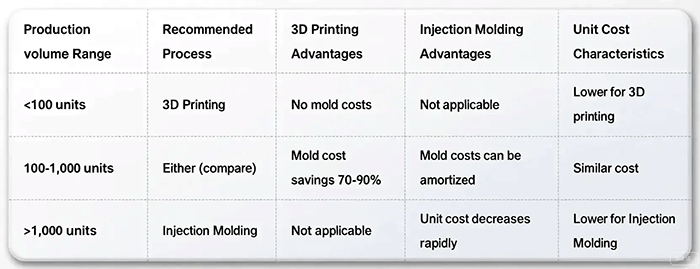
3D Printing vs Injection Molding: A Guide to Selecting the Optimal Process Based on Production Volume

Scenario 1: Fewer than 100 parts

Go with 3D printing without hesitation.

You skip expensive mold costs entirely, can update and iterate designs fast, and it’s far more budget-friendly than building a brand-new injection mold.

Scenario 2: 100 to 1000 parts

You have two solid options: use 3D printed rapid molds for injection molding, or print parts directly with a 3D printer.

3D printed rapid molds cut mold development costs by 70% to 90% compared to traditional metal molds, though they don’t last as many production runs.

Direct 3D printing skips mold making altogether, gets your parts ready faster, but the unit price will be a bit higher.

Scenario 3: More than 1000 parts

Injection molding is the clear winner here.

Even though upfront mold costs are high, the cost per unit drops drastically when spread over mass production. Based on real industry case data, injection molded parts can cost over 85% less per piece than 3D printed alternatives.

For structural components that demand strict material quality and high load-bearing performance — such as automotive parts and medical load-bearing components — manufacturers mostly rely on injection molding.

On the other hand, 3D printing works perfectly for prototype testing, custom one-off parts, and components with complex internal cavities that are tough to machine normally.

At the end of the day, you can’t choose a manufacturing process based only on quantity. You also need to factor in strength requirements, production timeline, material type, and surface finish quality.

In real manufacturing workflows, these two technologies often work side by side.

Teams use 3D printing to iterate designs quickly, test prototypes, and even make rapid molds. Then injection molding takes over for large-scale mass production.

They complement each other perfectly, and this combination has become one of the most practical solutions in modern manufacturing.

Blog

Post navigation

Previous Post: 3Cámara de expansión de impresión 3D (Tuned Pipe, Tubo de escape para motores de dos tiempos) Servicio de Source Factory
Next Post: 3Moldes de inyección para impresión 3D: Reducir costes & Acelera los plazos de entrega para la producción de lotes pequeños (Casos prácticos )

Atención al cliente
Preguntas frecuentes
Modificación gratuita de dibujos en 3D
Dibujo 3D personalizado gratis (Disponibilidad limitada)

Avisos legales
Política de envíos
Política de devoluciones y reembolsos
Declaración de privacidad
Condiciones del servicio
Aviso legal
Descargo de responsabilidad
Política de cookies

Quiénes somos
Vídeo de visita a la fábrica
Blog
Cooperación
Acerca de DT
Contacto

YouTube Twitter TikTok Facebook Instagram Quora LinkedIn Pinterest Reddit Medium


Copyright © 2025 DT 3D Printing
Todos los derechos reservados.
Desarrollado con PressBook Grid Blogs Theme


Gestionar el consentimiento de cookies
Para ofrecer la mejor experiencia, Usamos tecnologías como las cookies para almacenar y/o acceder a la información del dispositivo. Dar tu consentimiento para estas tecnologías nos permitirá procesar datos como el comportamiento de navegación o los identificadores únicos en este sitio web. No dar el consentimiento o retirarlo, puede afectar negativamente a ciertas características y funciones.
Funcional Siempre activo
El almacenamiento o acceso técnico es estrictamente necesario para el fin legítimo de permitir el uso de un servicio específico solicitado explícitamente por el suscriptor o usuario, o con el único fin de llevar a cabo la transmisión de una comunicación a través de una red de comunicaciones electrónicas.
Preferencias
El almacenamiento o acceso técnico es necesario para el fin legítimo de almacenar preferencias que no han sido solicitadas por el suscriptor o el usuario.
Estadísticas
El almacenamiento técnico o el acceso que se utiliza exclusivamente con fines estadísticos. El almacenamiento técnico o el acceso que se utiliza exclusivamente con fines estadísticos anónimos. Sin una citación judicial, cumplimiento voluntario por parte de tu proveedor de servicios de Internet, o registros adicionales de terceros, La información almacenada o recuperada únicamente con este fin no suele poder utilizarse para identificarte.
Marketing
El almacenamiento técnico o el acceso son necesarios para crear perfiles de usuario con el fin de enviar publicidad, o para rastrear al usuario en un sitio web o en varios sitios web con fines de marketing similares.
  • Gestionar opciones
  • Gestionar servicios
  • Gestionar {número_de_proveedores} proveedores
  • Más información sobre estos objetivos
Ver preferencias
  • {Título}
  • {Título}
  • {Título}
Gestionar el consentimiento de cookies
Para ofrecer la mejor experiencia, Usamos tecnologías como las cookies para almacenar y/o acceder a la información del dispositivo. Dar tu consentimiento para estas tecnologías nos permitirá procesar datos como el comportamiento de navegación o los identificadores únicos en este sitio web. No dar el consentimiento o retirarlo, puede afectar negativamente a ciertas características y funciones.
Funcional Siempre activo
El almacenamiento o acceso técnico es estrictamente necesario para el fin legítimo de permitir el uso de un servicio específico solicitado explícitamente por el suscriptor o usuario, o con el único fin de llevar a cabo la transmisión de una comunicación a través de una red de comunicaciones electrónicas.
Preferencias
El almacenamiento o acceso técnico es necesario para el fin legítimo de almacenar preferencias que no han sido solicitadas por el suscriptor o el usuario.
Estadísticas
El almacenamiento técnico o el acceso que se utiliza exclusivamente con fines estadísticos. El almacenamiento técnico o el acceso que se utiliza exclusivamente con fines estadísticos anónimos. Sin una citación judicial, cumplimiento voluntario por parte de tu proveedor de servicios de Internet, o registros adicionales de terceros, La información almacenada o recuperada únicamente con este fin no suele poder utilizarse para identificarte.
Marketing
El almacenamiento técnico o el acceso son necesarios para crear perfiles de usuario con el fin de enviar publicidad, o para rastrear al usuario en un sitio web o en varios sitios web con fines de marketing similares.
  • Gestionar opciones
  • Gestionar servicios
  • Gestionar {número_de_proveedores} proveedores
  • Más información sobre estos objetivos
Ver preferencias
  • {Título}
  • {Título}
  • {Título}