
The Big Picture
The global lure fishing market hit $13 billion in 2023. China leads the pack, and here’s a stat that might surprise you: over 60% of new anglers are Gen Z (18–35 years old).
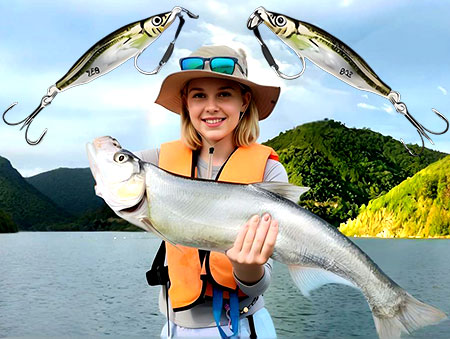
With so many young people jumping into the sport, demand for customized, personalized lures has exploded. Traditional manufacturing just can’t keep up — it’s too slow and too expensive.
Take lure molds. In the old days, getting a mold made took at least a week, and a single set of tooling could set you back thousands of dollars. Want to tweak the design? That money’s gone. Τώρα, 3D printing is flipping the entire industry on its head.
From Weeks to Hours: Industrial 3D Printing vs. Traditional Molds
Here’s a quick comparison to show you how much has changed.
| What We’re Comparing | 3D Printing Mold | Traditional (CNC / EDM / Casting) |
|---|---|---|
| Lead time | Hours to 3 ημέρες | 1–2 weeks (steel molds: 4–12 weeks) |
| Upfront cost | Low – $70 σε $500 | High – Aluminum: $400–$4k+; Steel: $5k–$15k+ |
| Lifespan (shots) | FDM: 10–50 / SLA: 50–200 / SLS: 200–800 / SLM (αλουμίνιο): 500–5k, (steel): 5k–20k | Αλουμίνιο: 1k–10k+; Steel: 100k+ |
| Cost per part | Higher (mold wears out faster) | Super low (spreads out over volume) |
| Design freedom | Insane – any geometry, undercuts, complex channels | Moderate – needs splits, sliders, core pins |
| Surface & accuracy | Depends: FDM so-so, SLA/DLP very smooth, SLM near-CNC | CNC: ±0.0004″, Ra 0.8µm |
| Materials you can mold | Limited for FDM/SLA (low heat resistance); SLS/SLM can handle high temps | Wide range – can take high pressure & heat |
| Best batch size | Prototypes to small runs (1–500 pcs) – metal prints can go to a few thousand | Μεσαίο (1k+) to mass production (100k+) |
Real-World Example: Weihai Yunyi – From Drawing to Mold in 6 Hours
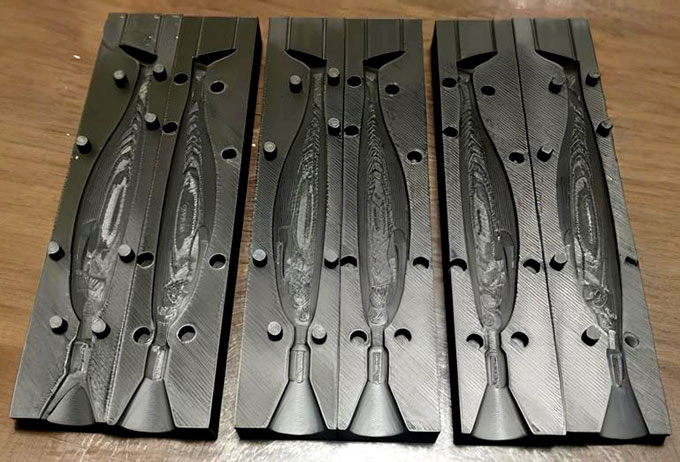
Weihai Yunyi Intelligent Technology is a perfect example. Their general manager told us: “We get a CAD file at 9 AM, and by 3 PM we have a printed lure ready for assembly testing.” That’s just six hours from idea to physical part. In the old world, the same process took at least a week – almost 30x slower.
And cost? A traditional lure mold runs thousands of dollars. Printing one batch of lure molds? About $15. That’s not a typo. The difference is massive.
Plus, 3D printing nails those tricky geometries that CNC machines struggle with – deep cavities, undercuts, internal channels. No sweat.
Which 3D Printing Tech Should You Use for Lure Molds?
Here’s a breakdown of the four main options. Read it like a cheat sheet.
| Factor | FDM | SLA / DLP | SLS | SLM |
|---|---|---|---|---|
| How it works | Melts plastic filament (PLA, PETG) layer by layer | UV light cures liquid resin | Laser sinters nylon powder | Laser melts metal powder (Από, Προς, steel) |
| Accuracy | ±0.004–0.012″, visible layer lines | ±0.001″, smooth (Ra<1μm) | ±0.002–0.004″, powdery finish | ±0.0008–0.002″, near-CNC |
| Fine details | So-so (min feature ≥0.02″) | Excellent (≥0.004″) – fish scales, hook grooves | Good (≥0.012″) for complex cavities | Very good (≥0.008″) for fine metal features |
| Mold lifespan (shots) | PLA:10–20 / PETG:20–50 / ASA:30–60 | Standard resin:50–100 / high-temp:100–200 | Νάιλον 12:200–500 / glass-filled:300–800 | Αλουμίνιο:500–5k / tool steel:5k–20k |
| Heat resistance | Poor (PLA:140°F, PETG:175°F, ASA:195°F) | Moderate (standard:175–250°F, high-temp:300–390°F) | Good (nylon:355°F, glass-filled:390°F+) | Excellent (Προς:1100°F+, steel:1800°F+) |
| Material cost (per mold, USD) | Super low: PLA $0.7–1.4 / PETG $1.4–2.8 | Moderate: standard $4–11 / high-temp $11–21 | Υψηλό: nylon $11–21 / glass-filled $21–36 | Very high: Al powder $70–140 / steel $140–285 |
| Printer cost (USD) | Hobby: $150–400 / Industrial: $700–2800 | Desktop: $700–2800 / Industrial: $2800–14k | Industrial: $70k+ | Industrial: $140k+ |
| Μετα-επεξεργασία | Low – sand off supports | Medium – wash, cure, remove supports, sand | Medium – clean powder, bead blast | High – bead blast, heat treat, remove supports, finish |
| Print time | Μεσαίο: small mold 4–8h, large 8–24h | Short: small 2–6h, large 6–18h | Long: small 6–12h, large 12–36h | Very long: small 10–24h, large 24–72h |
| Best for | Simple soft lure molds, DIY | Detailed soft lures, hard bait prototypes, silicone master molds | Medium-run hard baits, heat-resistant molds | High-end metal molds, conformal cooling, custom metal tooling |
| Main downsides | Low accuracy, low heat resistance, tough supports | Brittle, material costs, ages over time | Super expensive printer, messy powder, average surface | Crazy expensive, slow, lots of post-processing |
When Does 3D Printing a Lure Mold Actually Make Sense?
1. Prototyping & Design Validation (Το #1 use case)
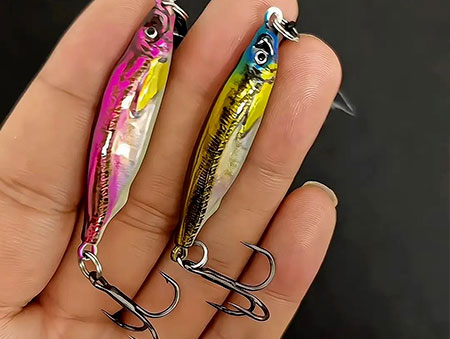
- Perfect for testing new designs, swim action, and market appeal before committing to mass production.
- Why it rocks:
- Iterate fast – from design to mold in24–48 hours (5–10x faster than traditional).
- Low-stakes trial – no huge tooling bill if the design flops.
- Build anything – deep cavities, undercuts, conformal cooling channels – all in one piece.
- Go with: SLA/DLP for high detail / FDM for low cost / SLS for durability in medium test runs.
- Who uses it: designers, DIYers, small brands, engineers validating geometry.
2. Small-Batch Custom Production (≤500 pieces)
- Perfect for custom orders, niche lures, local favorites, or garage workshops.
- Why it rocks:
- No huge upfront mold cost, so low-volume products become profitable.
- Fast turnaround for custom requests.
- Works with different molding methods (hand pour, low-pressure injection).
- Go with:
- Soft lures: SLA + silicone casting (great detail, low cost).
- Hard lures: SLS nylon (handles 50–200 injection shots).
- DIY: FDM in PETG (cheapest, good for 10–50 pours).
- Who uses it: fishing clubs, pro anglers wanting personal baits, species-specific lures, tournament specials.
3. Testing Complex Undercuts & Weird Geometry
- Perfect for lures with deep cavities, undercuts, complex parting lines, or built-in rattle channels – stuff that’s a nightmare with conventional molds.
- Why it rocks:
- Print the complex cavity directly – no splitting the design or adding expensive sliders.
- When you cast with soft silicone, the mold just peels off those tricky shapes without damaging the part.
- Go with: SLA master + platinum-cure silicone (best detail + easy release).
- Who uses it: multi-joint soft baits, hard baits with internal rattles, weird biomimetic lures, prototypes for complex swim actions.
4. Fast Market Response & Rush Orders
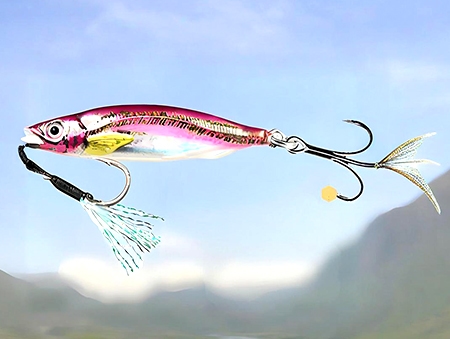
- Perfect for launching new products before competitors, urgent custom orders, or last-minute tournament baits.
- Why it rocks:
- Under 3 ημέρες from idea to finished mold – unheard of with traditional tooling.
- Print several molds in parallel to test multiple design variations at once.
- Go with: SLA (fastest) + low-pressure injection molding.
- Who uses it: seasonal hot-species baits, “feeding frenzy” response lures, trade show sample runs.
That’s the real deal. 3D printing isn’t here to replace traditional mold making for huge production runs – but for speed, customization, and killing it in the prototype-to-small-batch zone, it’s unstoppable.
We are a 3D printing source factory with dozens of metal 3D printers and dozens of CNC machines, which combines the advantages of both 3D printing and traditional CNC machining.
If you’re ready to turn your lure ideas into real products without blowing your budget on steel tooling, let’s talk.
Special offer for new customers!