

Let’s cut straight to it: if you’re building high-density AI server racks, air cooling is no longer cutting it. GPU power densities are blowing past 1kW per chip, and even the best fan arrays can’t move enough air to keep temps in check. Liquid cooling isn’t a “future trend” anymore — it’s table stakes.
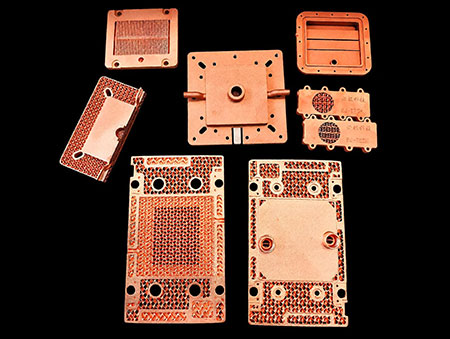
But here’s the problem most teams run into: standard cold plates weren’t built for this level of heat flux. Tube-bonded, brazed, and friction-stir-welded designs all have hard limits on performance, reliability, or both.
That’s where 3D printed copper liquid cold plates come in. By printing the entire plate as one single solid piece, we can pack in far more heat transfer surface, optimize flow paths exactly to your chip layout, and eliminate the leak points that plague assembled cold plates.
On this page, we’ll break down how 3D printed copper cold plates work, what they deliver for server and data center applications, and why more engineering teams are switching from traditional designs. This is part of our full lineup of 3D printed copper & copper alloy thermal management solutions, so you can see how cold plates fit into your overall thermal strategy.
Why Traditional Cold Plates Hit a Wall in High-Density AI Servers
If you’ve spec’d cold plates for server builds before, you already know the tradeoffs. Every traditional manufacturing method comes with compromises that get worse as power densities go up.
Tube-bonded cold plates are cheap, but the tubes only make partial contact with the base plate. That creates thermal resistance right where you need heat transfer the most. For low-power CPUs they’re fine, but for modern AI GPUs, they leave way too much performance on the table.
Brazed and friction-stir-welded plates perform better — you get full microchannels — but they come with a huge catch: seams. Every joint between the base and the cover is a potential leak point. Over thousands of thermal cycles in a data center environment, those seams degrade. One leak can take out an entire server tray — and with high-end AI GPUs, the downtime and hardware replacement cost is brutal.
On top of that, you’re stuck with straight, uniform parallel channels. You can’t tailor the flow to match actual hotspots on the die. You end up overcooling some areas and undercooling others, wasting coolant flow and leaving thermal headroom unused.
For a long time, that was as good as it got. Not anymore.
3D Printed Monolithic Copper Cold Plates: No Seams, No Compromises
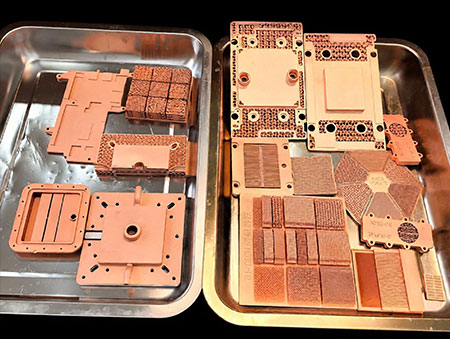
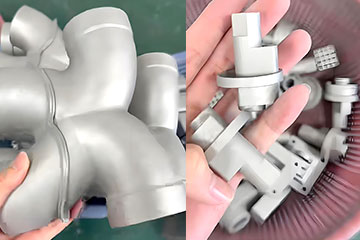
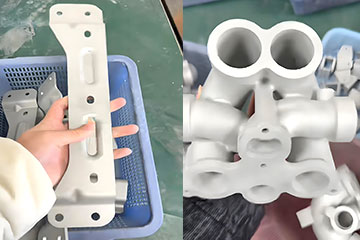
The biggest difference with 3D printing is simple: the entire cold plate prints as one single solid part. No assembly, no bonding, no welds, no seams. Zero leak points, period.
We print using optimized SLM (Valikoiva lasersulatus) processes with pure copper or copper alloys, depending on your pressure and durability needs. The result is a monolithic cold plate with internal geometry you could never machine or assemble — and thermal performance that blows traditional designs out of the water.
Here’s what that actually means for your server cooling loop:
Ultra-dense microchannels for maximum surface area
We reliably print microchannels as small as 0.3mm in diameter, with 0.2mm thin walls between them. That lets us pack far more heat transfer surface into the same footprint than any milled or brazed design. More surface area = more heat pulled off the die, in the same space.
Unlike machined channels, which have to be straight and uniform, we can taper, widen, or narrow channels to match your exact heat map. That means more flow over hotspots and less flow where it’s not needed — better temperature uniformity across the entire GPU or CPU.
Internal lattice cores for next-level heat transfer
If you really want to push performance, we can fill the cold plate with TPMS (Triply Periodic Minimal Surface) lattice structures instead of standard channels. These porous, repeating geometries deliver way more surface area per unit volume than even the densest microchannels, and they promote turbulent coolant flow for even better heat transfer.
It’s a step change in cooling performance, and it’s only possible with 3D printing. We break down the full performance numbers in our guide to TPMS lattice porous cooling structures.
Conformal flow paths that match your chip layout
No more forcing a square channel grid onto a rectangular die with off-center hotspots. We can design flow paths that curve, split, and merge exactly to match the heat source layout on your chip, interposer, or package.
That translates to lower peak temperatures and better temperature uniformity — which directly means more stable boost clocks, longer component life, and fewer thermal throttling events.
Pure Copper vs Copper Alloy: Which Is Right For Your Server Build?
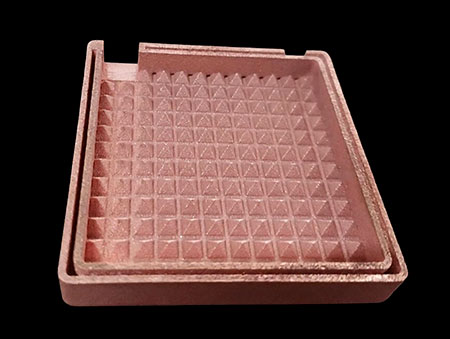
One question we get all the time: should I go with pure copper or a copper alloy for server cold plates?
For most standard data center liquid cooling loops, pure copper is the default pick — and for good reason. At 390–410 W/m·K, it delivers maximum thermal conductivity, and low-pressure data center loops don’t demand extreme mechanical strength.
If you’re running high-pressure cooling systems, or building cold plates for ruggedized edge servers that see vibration and shock, a copper alloy like CuCrZr is usually the better call. You give up a small amount of conductivity (320–350 W/m·K) but gain much higher strength and fatigue resistance.
We go deep on material tradeoffs, printability, and cost in our full pure copper vs copper alloy comparison guide. If you’re on the fence, that page will walk you through the decision step by step.
Ulkomaisten B2B-asiakkaiden suosittelut
“Olin hyvin huolissani, että jotain pahaa tapahtuisi. Mutta tuotteen vastaanottamisen jälkeen, Huomasin, että huoleni oli täysin turha. DT 3D Printing on erittäin luotettava tehdas, jonka laatu on taattu.”

“Tuotteen laatu on huippuluokkaa – notch, käsityö on hienoa, tulostustulos on erinomainen, ja toimitusnopeus on todella nopea. Yleistä, Se tarjoaa erinomaista vastinetta rahalle, ja olen erittäin tyytyväinen.”


“Tulostuslaatu on todella hyvä, ja hinta on varsin edullinen. Myös logistiikka on nopeaa. Kaiken kaikkiaan, DT on luotettava tehdas, ja jatkamme yhteistyötä heidän kanssaan pitkällä aikavälillä.”


What This Delivers For Data Centers & Server Builds
Better thermal performance is great on paper, but what does it actually do for your deployment?
Higher compute density
With better cooling per square inch, you can run higher-power GPUs and CPUs in the same rack space, or pack more servers into the same footprint. For AI training clusters, that directly translates to faster training times and more compute per dollar of rack infrastructure.
Zero leak risk = less downtime
Monolithic construction means there are no seams to fail over time. For data centers running 24/7, that’s a massive reliability win. You avoid the cost and headache of cold plate leaks that can damage expensive hardware and take workloads offline.
Simplified supply chain
Instead of sourcing machined halves, brazing services, leak testing, and assembly from multiple vendors, you get a finished, tested cold plate from a single supplier. Fewer touchpoints = fewer delays, fewer quality issues, and simpler procurement.
Faster design iteration
If you’re iterating on server thermal designs, 3D printing lets you test new channel layouts or lattice configurations in days instead of weeks. No tooling costs, no long lead times for custom machined parts — just print the new design, test it, and iterate.
The Big Myth About 3D Printed Cold Plates
We hear this one constantly: “3D printed internal features will clog up my cooling loop and cause high pressure drop.”
Let’s set the record straight: when printed with a tuned, production-grade process, 3D printed copper cold plates have clean, consistent internal surfaces. We use standard post-processing steps to remove loose powder and smooth internal channels, so they’re fully compatible with standard data center coolant loops and filtration setups.
Pressure drop depends entirely on your geometry. A dense microchannel or lattice design will have higher drop than a basic wide-channel plate — that’s just thermofluids 101. But we design for your target pressure drop from day one, balancing surface area and flow resistance to hit your exact system specs.
Bottom line: don’t write off 3D printed cold plates because of old horror stories from early, unoptimized processes. Modern production parts are reliable, consistent, and ready for 24/7 data center duty.
Usein kysyttyjä kysymyksiä

Are 3D printed copper cold plates really leak-proof?
Yes — because there’s nothing to leak. Unlike brazed or welded plates, our cold plates are printed as one single monolithic piece with no internal joints or seams. Every plate undergoes pressure testing to your required specification before it ships.
What pressure rating can you achieve?
That depends on material and wall thickness. Pure copper plates work great for typical closed-loop data center systems (1–3 bar operating pressure). For high-pressure systems, copper alloy designs can handle much higher pressures. We’ll spec the right material and wall thickness for your exact operating conditions.
Can you match existing cold plate footprints and mounting holes?
Ehdottomasti. Most clients come to us with an existing form factor they want to upgrade. We can match your current mounting pattern, port locations, and overall dimensions, then upgrade the internal geometry for better performance. It’s a drop-in replacement with no redesign of your server tray required.
How long does it take to get prototype cold plates?
For standard prototype builds, we typically turn around first articles in 10–15 business days after design finalization. Production lead times scale with order quantity, and we’ll give you a firm timeline with your quote.
Do you offer design support?
Kyllä. Our engineering team will review your thermal requirements and give you a full DFM (Design for Manufacturing) review, including recommendations on channel layout, material choice, and geometry optimization. We don’t just print what you send us — we help you make it better.
Ready To Upgrade Your Server Cold Plate Performance?
If you’re hitting thermal limits with your current cold plate design, or you’re planning a new high-density AI server build, puhutaanpa.
Send us your CAD file, heat load specs, and pressure drop targets, and our engineering team will get back to you with:
- A full DFM review
- A clear material recommendation (pure copper or alloy)
- Expected thermal performance estimates
- Firm pricing and lead time
No generic sales pitches, just straight engineering feedback from people who build copper cold plates for data centers every day.
Request your free design review today and see how much thermal headroom you can unlock.
Keep exploring
- Pure Copper vs Copper Alloy 3D Printing: Full Comparison
- TPMS Lattice Porous Structures for Next-Gen Copper Cooling
- Design Guide for 3D Printed Copper Heat Exchangers
- Pure Copper 3D Printing Technology for Advanced Thermal Management


Meistä
1. We are a professional metal 3D printing manufacturer.
2. Valmistamme 3D-tulostettuja metalliosia autoteollisuudelle, lääketiede, lentokone, ilmailu ja avaruusteollisuus, drone, ja veneilyteollisuudessa, käyttämällä materiaaleja kuten ruostumatonta terästä, titaani, kupari, alumiini ja sen seokset.
3. Tarjoamme kattavan 3D-tulostuspalvelun.
Palveluihimme kuuluvat:
SLM / BJ / SLA / MJF / FDM / SLS / DLP, CNC machining and post-processing
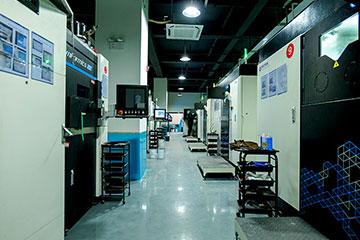
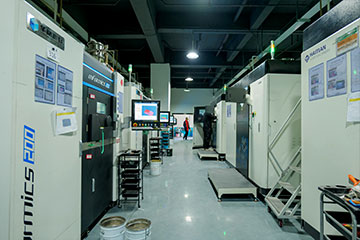
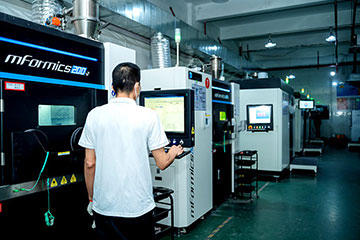
4. Omistamme 33 SLM-metalliset 3D-tulostimet, 14 CNC machining tools, 60 muoviset 3D-tulostimet, 50 BJ 3D printers (owned by another company in which DT has invested), ja luvut kasvavat edelleen.
5. We are a source factory for many global 3D printing service providers.
Miksi valita meidät?
- We have manufactured numerous pure cooper and cooper alloy thermal management components via 3D printing using copper and copper alloys for clients all over the world.
- Tarjoamme oma tuotanto with 33 high-end industrial SLM metal 3D printers, 14 CNC-koneet ja 50 industrial BJ 3D printers (Owned by another factory in which we have an investment).
- Erikoistarjous uusille asiakkaille
- Vahvuutemme on SLM-metallitulostus. Omistamme 33 huippuluokan SLM-metalliset 3D-tulostimet, useimmat maksavat noin $150,000 kukin, ja kalustomme kasvaa edelleen.
- Ei vähimmäistilausmäärää (Vähimmäistilausmäärä) pakollinen. Voimme räätälöidä sinulle jopa yksittäisen tekstin.
Ota rohkeasti yhteyttä, jos sinulla on kysyttävää..
Minimitilausmäärää ei ole. (Vähimmäistilausmäärä) raja tähän. Voimme räätälöidä sinulle jopa vain yhden tekstin.
Tervetuloa konsultointiin.