

In the automotive industry, we not only have 3D printed car parts, but also a lot of 3D printed accessories.
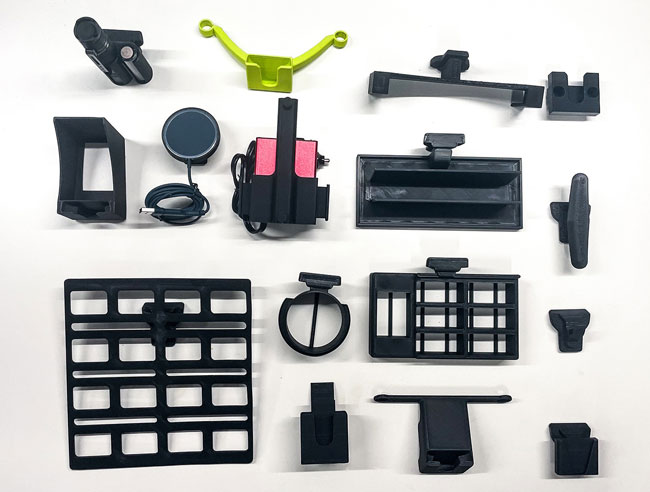
Image: Courtesy of Ford Motor Company
Let’s dive into the most exciting real-world 3D printing use cases that are reshaping the automotive accessories landscape.
Industrial-Grade High-Performance Parts: Where Every Gram Counts
For racing teams and supercar manufacturers, weight reduction isn’t just about speed—it’s about survival. 3D printing’s additive manufacturing process makes it the perfect solution for creating lightweight yet incredibly strong components that traditional methods simply can’t match.
Case Study: 3D Printed Titanium Brake Calipers (40% Lighter)
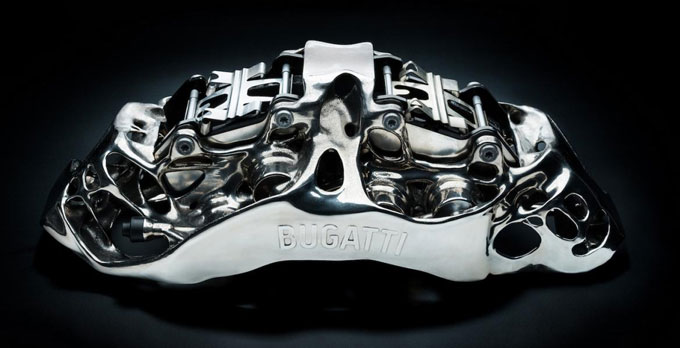
Image: Courtesy of Bugatti
Bugatti set the benchmark here with its Chiron hypercar, which features the world’s largest 3D printed titanium brake caliper. Measuring 41cm long, 21cm wide, and 13.6cm tall, this massive component weighs just 2.9kg—compared to 4.9kg for a conventional aluminum caliper. That’s a 40% weight saving without sacrificing any rigidity or stopping power. The printing process took 45 営業時間, building up the caliper layer by layer (2,213 layers total) to create a structure that’s both stronger and lighter than anything machined from a solid block.
Case Study: 3D Printed Intake Manifolds
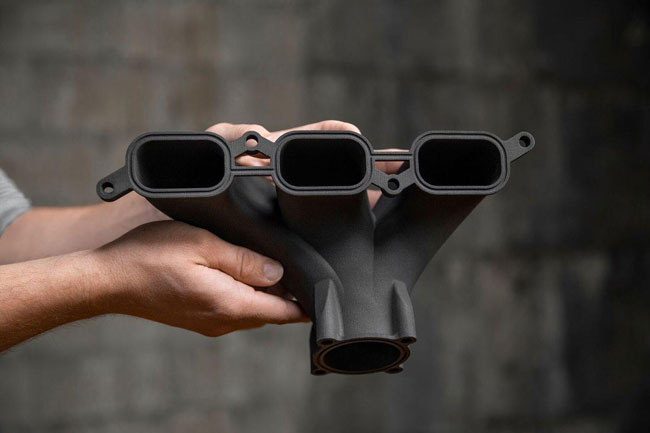
Image: Courtesy of Yingpu Additive Manufacturing
DTMRS Racing turned to SLS 3D printing technology to create V8 engine intake manifolds from glass-fiber reinforced nylon. The finished parts weigh just 1.9kg and take about 13 hours to print; another design comes in at 2.5kg and prints in only 10 営業時間. That’s over 40% lighter than traditional metal manifolds.
But the benefits don’t stop at weight reduction. SLS technology boasts over 90% material efficiency, with unused powder fully recyclable. The entire design-to-production cycle is shortened by more than 80%, with print accuracy of ±0.2mm and near-perfect yield rates—completely eliminating the sand holes, air pockets, and other defects that plague traditional casting methods.
Case Study: 3D Printed Inconel Exhaust Manifolds for the Porsche 993
Exhaust manifolds have one of the toughest jobs in any car: withstanding 800°C+ exhaust gases, extreme thermal cycling, and constant vibration. Traditional manufacturing requires complex hand-bending and welding, making them expensive and time-consuming to produce.
Gunther Werks solved this problem for their Porsche 993 Speedster Remastered by using a fully 3D printed Inconel exhaust system. インコネル (a nickel-chromium superalloy) is ideal for high-temperature applications but notoriously difficult to machine using traditional methods.
The result? A lightweight, durable exhaust system that perfectly complements the car’s 4.0L flat-six engine (rebuilt by Rothsport Racing to produce 440 horsepower). This case proved that 3D printing can cost-effectively manufacture complex high-temperature alloy parts for limited-edition and high-end custom vehicles.
OEM Factory Custom Parts: Bridging the Gap Between Concept and Production
Major automakers are no longer keeping 3D printing confined to their R&D labs. They’re bringing it straight to the production line and putting it directly into the hands of consumers.
Case Study: Peugeot’s 3D Printed Lifestyle Accessories
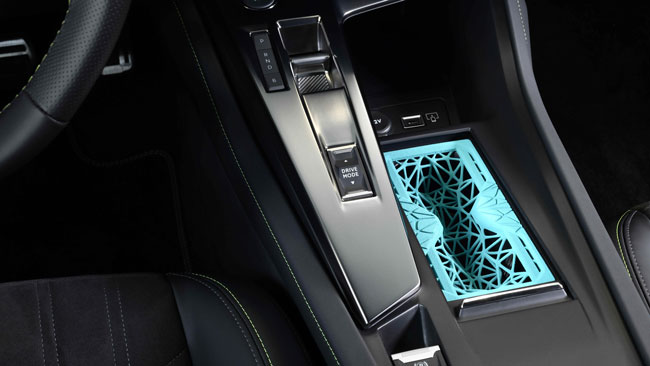
Image: Courtesy of Peugeot & HP Inc.
Peugeot took a consumer-first approach by launching a line of 3D printed accessories exclusively for the new 308 model. Available through Peugeot LIFESTYLE dealerships, the range includes sunglasses holders, cup holders, and phone/card organizers in black and mint green. This marked the first time 3D printing was used for factory-authorized accessories on a mass-produced Peugeot vehicle. The project was developed in partnership with HP, extending 3D printing from prototyping to retail-ready consumer products.
Case Study: Ford’s Open-Source 3D Printing Platform
Image: Courtesy of Ford Motor Company
Ford went even further with its Maverick pickup truck, which features the Ford Integrated Tether System (FITS). The truck comes with specially designed slots throughout the interior, and Ford has released free 3D printing templates and exact dimensions so owners can create their own custom accessories.
Official recommendations include cup holders, storage bins/trash cans, cable organizers, dual hooks, and under-seat storage dividers. This represents a major shift: automakers are now using 3D printing not just as an internal manufacturing tool, but as a platform for customer co-creation.
Case Study: Porsche’s Custom-Fit 3D Printed Bucket Seats
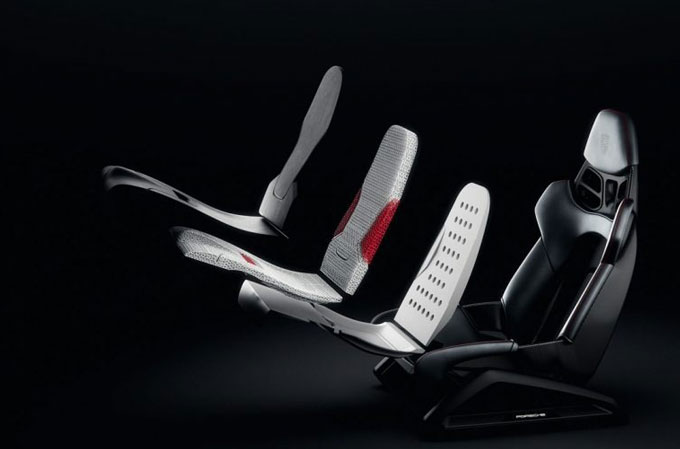
Image: Courtesy of Porsche
Porsche has taken personalization to the next level with its 3D printed body-contoured bucket seats, available as an option on 911 および 718 models since May 2020. The seat cushions and backrests are 3D printed, allowing customers to choose from three different firmness levels (soft, medium, hard) to perfectly match their body type and driving style.
Compared to traditional bucket seats, these 3D printed versions are over 8% lighter. The option costs approximately $2,900 USD (converted from 2,677.50 EUR at current exchange rates), making high-end custom seating accessible to more enthusiasts than ever before.
Aftermarket & Custom Modifications: The High-Value Small-Batch Revolution
The automotive aftermarket is where 3D printing is growing fastest. It’s perfectly suited for small-batch production, custom designs, and hard-to-find parts—creating a lucrative blue ocean market for innovative businesses.
Case Study: AXIS’s 3D Printed Interior Trim Parts
Japanese company AXIS has built a successful business specializing in 3D printed interior accessories for sporty models from Toyota, Honda, Mazda, Subaru, and Nissan. In April 2025, they added two Fuse 1+ 30W SLS 3D printers to their lineup, cutting product development time from 6 months to just 1 month. What used to take weeks of outsourcing for prototyping now happens in-house overnight.
3D printing also eliminated their tooling costs entirely. The two 3D printers produce 20-30 finished parts per day, and when combined with e-commerce sales, this speed advantage has become their biggest competitive edge.
Case Study: Illumaesthetic’s Custom Body Kits
What started as a university project in 2015 has grown into Illumaesthetic, a globally recognized brand in custom automotive parts. Based in California, the company operates five large-format Modix 3D printers producing custom bumpers, spoilers, air intakes, and other body components.
Their restoration team even uses 3D printing to reproduce exact replicas of front and rear bumpers for classic cars like the Nissan S13—parts that are otherwise impossible to find. The finished prints are virtually indistinguishable from original factory parts.
Case Study: Auto Additive’s Blockchain-Powered Parts Network
In the collision repair industry, Auto Additive is combining 3D printing with blockchain technology to solve two major problems: intellectual property protection and secure data transfer. Their global network of 3D printing partners produces parts on demand, ensuring that repair shops always have access to the exact components they need—without waiting for shipping from distant warehouses.
DIY Consumer Accessories: The Affordable Revolution for Every Car Owner
One of the most exciting aspects of 3D printing is how it’s put the power of manufacturing into the hands of regular car owners. Now anyone with a 3D printer can create custom accessories for just a few dollars.
Ford’s FITS system has spawned a massive community of DIY designers. Owners have created everything from MagSafe phone mounts that clip directly into the console slots (no suction cups or adhesive needed) to custom storage solutions. For these parts, PETG or ABS filament is recommended over PLA, as it can withstand the 70°C+ temperatures inside a car on a hot summer day without warping.
Jeep owners have developed an especially vibrant 3D printing culture. From duck-shaped tow hook covers to magnetic trim pieces, you can create fully customized decorations for just a few cents worth of plastic. Most of these parts print in just a few hours.
Practical everyday accessories are also incredibly popular. You can print trash cans that fit perfectly in door pockets or cup holders (complete with rotating lids), sun visor sunglasses holders (one of the easiest 3D printing projects ever, taking just minutes), and tissue boxes that match your car’s interior color scheme.
As material science advances, DIY 3D printed parts are becoming more reliable than ever. For high-temperature environments, stick to PETG or ABS instead of PLA. For load-bearing parts like phone mounts, choosing the right engineering plastic will ensure they stay strong even in extreme heat.
Final Thoughts
3D printing is revolutionizing the automotive industry from every angle. On the development side, it’s cutting lead times from 6 月を 1 month. In manufacturing, it’s consolidating dozens of separate parts into single, integrated components. And for consumers, it’s turning custom accessories from luxury items into everyday necessities.
As the 3D printing technology becomes more accessible and affordable, the power to design and create car parts is shifting from factories to individual owners. Whether you’re a racing engineer chasing every last tenth of a second, a business owner looking to enter the aftermarket, or just a car enthusiast who wants to add a personal touch to your ride, 3D printing has something to offer.
注記:
All industry case study images are the property of their respective owners. Used for educational and reference purposes only.