

1. Kicking Things Off
Automakers aren’t just using 3D printing for prototypes and tooling anymore.
They are using 3D printing now to make real, production-grade parts: engine components, chassis structures, brake systems, body frames, and even service spares.

That’s because 3D printing has so many advantages over traditional production like CNC, as shown in this illustration below.

This article walks you through the real-world side of 3D printed auto parts—from engine bits to body panels, brakes, race car gear, and replacement parts. We’ll share actual stories and numbers along the way.
2. Engine Core Parts: From Exhaust Valves to Cylinder Heads
2.1 3D Printed Exhaust Valves: LPBF Beats Traditional Casting
The exhaust valve is a tough nut to crack. It sits inside an internal combustion engine, dealing with extreme heat, high pressure, and constant cycling. In a 2026 study published by Springer, researchers compared laser powder bed fusion (LPBF) against conventional casting for making a diesel engine exhaust valve.
They used Inconel 718 to print complete exhaust valves, then checked porosity and surface roughness with micro-CT scans. The results? LPBF parts had much lower surface roughness at every measured spot. SEM images showed narrow, deep wear marks on the cast valve heads, while the LPBF ones barely had any wear. CT scans confirmed that LPBF parts had far less porosity, which means better fatigue strength and reliability.
The takeaway: even for the toughest moving parts in an engine, 3D printing has moved from “just for prototypes” to “actually improves performance.”
2.2 3D Printed Pistons: 10% Lättare, +30 HP
In high-performance engines, piston weight directly affects throttle response and power output.
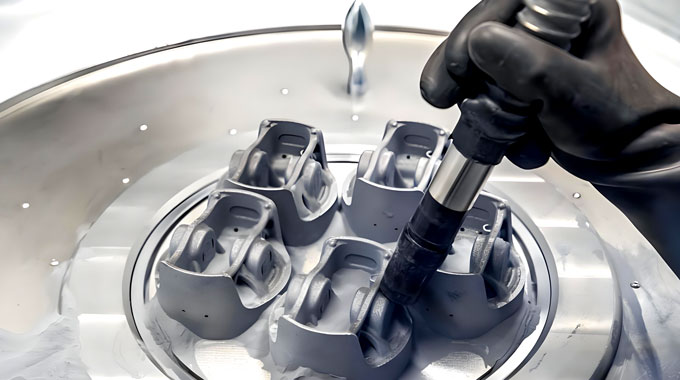
Porsche pulled off a real breakthrough with the pistons in its 911 GT2 RS. Using laser metal fusion (LMF) and high-purity metal powder, they printed pistons that are 10% lighter and add 30 more horsepower. The 3D printing process let them build internal cooling channels right into the pistons—something traditional manufacturing just can’t do. That drastically improved combustion efficiency and heat management.
On a broader scale, research on titanium alloy pistons shows similar benefits. With topology optimization and 3D printing, titanium pistons slash reciprocating mass, boosting engine response and fuel economy.
2.3 3D Printed GT3 Cylinder Head: 168 Hours of Nonstop Printing
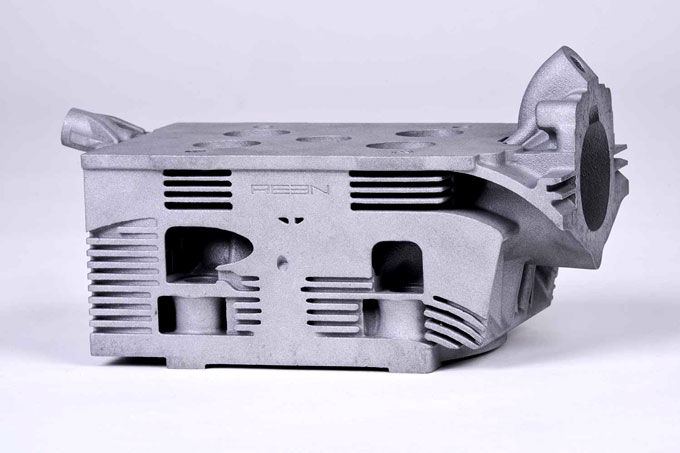
In January 2026, BÖLLINGER GROUP and REEN unveiled the world’s first 3D printed air-cooled GT3-style cylinder head. They used aluminum powder and ran a continuous metal additive process for a full 168 timmar, building up a cylinder head with intricate internal cooling channels. The shape and layout of those channels would be nearly impossible to cast the traditional way. After 3D printing, they finished it with high-precision CNC machining and quality checks to make sure it could handle extreme conditions.
The 168-hour printing and the final performance show that for high-value, high-performance engine parts, 3D printing is moving from “cool demo” to “legit production tool.”
2.4 Sand Printing for Engine Blocks: A Digital Upgrade for Casting
We don’t directly print engine blocks (not yet anyway), but 3D printing is changing how we cast them—especially sand molds.
A 2025 study showed real results using binder jetting to print sand cores for engine blocks. Three key cores ended up 42%, 37%, och 51% lättare, while combining several complex features into one single core.
The beauty of 3D printed sand cores? No draft angle needed. That means engineers can design purely for performance and thermal efficiency, without worrying about whether the part can actually be cast.
3. Chassis & Brake Parts: Where Weight Loss Really Matters
3.1 3D Printed Bugatti’s Titanium Brake Caliper: Över 40% Lättare
The brake caliper is one of the most iconic success stories for 3D printing in chassis parts.
Back in January 2018, Bugatti released the world’s first 3D printed titanium eight-piston monobloc brake caliper for the Chiron. It measures 41 cm long, 21 cm bred, och 13.6 cm high, and weighs just 2.9 kg. Compared to the Chiron’s aluminum caliper (4.9 kg), that’s a 2 kg drop—more than 40% lättare. And the titanium caliper is actually stronger than aluminum. Lighter and tougher at the same time.
Printing one caliper takes about 45 timmar, plus another 11 hours of CNC finishing, for a total of around 56 timmar. Wall thickness ranges from 1 till 4 mm.
Bugatti said at the time it was the largest additively manufactured titanium functional part in the world. BLT has also done a ton of work in this space. Using topology optimization and simulation, they set a max stress target of 320 MPa. After optimization, front-axle weight dropped 39.6%, and rear-axle weight dropped 48.8%. Compared to cast versions, additively manufactured titanium brake calipers weigh over 30% less, without sacrificing stiffness or heat resistance.
3.2 3D Printed Suspension Knuckles: 36.1% och 32.8% Weight Savings
Suspension knuckles take loads from all directions. For a Formula Student team, BLT made front and rear knuckles using high-strength aluminum on a PBF-LB/M machine. The printed knuckles fit right into the suspension with no interference. Compared to conventional CNC machining, the front knuckle weighed 36.1% less, and the rear one 32.8% less.
Sanhuan Forging also worked on steering knuckles for EVs. Using additive manufacturing, they achieved a 5%–10% weight advantage over competitors and cut product development time by more than 20%. Their one-piece knuckle-and-arm design won a China Patent Excellence Award.
McLaren’s W1 supercar, launched in late 2024, uses 3D printed titanium front knuckles and suspension arms. The W1 weighs just 1,399 kg and packs over 1,200 hästkrafter. That insane power-to-weight ratio owes a lot to additively made suspension parts.
3.3 3D Printed Titanium Door Hinges: About 50% Lättare
At the 2025 Formnext show, BLT showed off an integrated titanium door hinge made from their own BLT-S-Ti64 powder. Compared to traditional cast aluminum or forged steel hinges, this one keeps the same strength and reliability but cuts weight by roughly 50%. That’s a real win for unsprung mass and overall efficiency.
3.4 Rear Axle Carrier: Hollow Lattice Design Breakthrough
For large EV structural parts, BLT demonstrated a one-piece 3D printed rear axle carrier. The design uses a hollow structure with just 2 mm thick walls, filled with internal lattices to optimize force paths. Total weight is about 20% lighter than traditional cast or welded designs, while still meeting all strength and stiffness requirements.
4. Car Body Structures: From Trim Parts to Load-Bearing Components
4.1 BMW i8 Roof Bracket: A Milestone for Production Metal 3D Printing
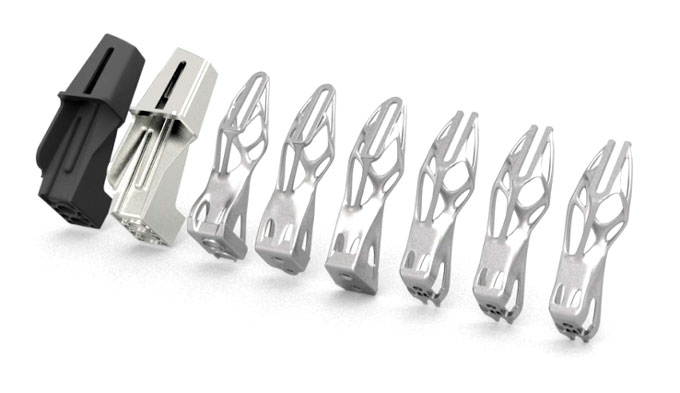
In 2018, BMW won an Altair Enlighten Award for a 3D printed metal convertible roof bracket used in the i8 Roadster. It was the world’s first metal 3D printed part in a mass-production passenger car. BMW’s metal additive manufacturing head, Maximilian Meixlsperger, had spent ten years designing within traditional manufacturing limits. But with selective laser melting (SLM), the design-to-production cycle dropped to just three months. The bracket uses a load-path design from topology optimization, cutting weight by 44% while increasing stiffness tenfold. And they could print over 600 of them in a single batch. Even better: no supports needed during printing, so post-processing was minimal.
4.2 BYD Yangwang U9X: World’s First 3D Printed High-Performance Body Structure
In October 2025, BYD showed off the Yangwang U9X’s integrated 3D printed body structure at the EuroCarBody 2025 conference. It’s a world first. Using BLT’s metal printing, they designed hollow chambers and rib structures inside the body. Compared to a solid part of the same weight, torsional stiffness went up by more than 200%. And the high-strength aluminum structure cut overall vehicle weight by over 30%. On key body parts, more than 90% of printed surfaces stayed within ±0.5 mm of spec.
The U9X set a production car speed record of 496.22 km/h at Germany’s ATP test track, and ran the Nürburgring Nordschleife in 6:59.157—two world records. BLT also supplied 20 3D printed high-performance brake calipers for the U9X, all of which passed endurance testing at the Ring. Thanks to topology optimization, those calipers are 20%–30% lighter, with internal fluid channels and inserts printed right in.
4.3 Cadillac CELESTIQ: Över 130 3D Printed Parts
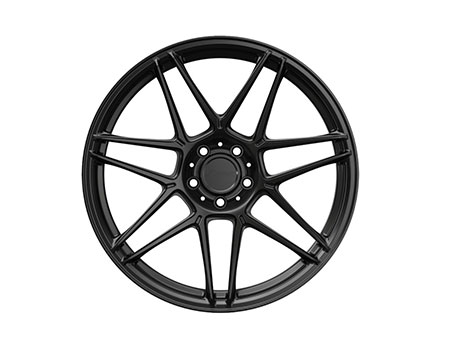
GM’s Cadillac CELESTIQ ultraluxury electric sedan shows how far additive can go in a production vehicle. It has more than 130 3D printed parts—the most of any GM model ever. These include a steering wheel center trim piece (GM’s largest production metal 3D printed part to date), a seatbelt adjustment guide ring (GM’s first 3D printed metal safety part, which won an award from the Metal Powder Industries Federation), plus window switches, armrests, and interior trim. All of them were developed at GM’s Additive Industrialization Center (AIC) in Warren, Michigan, a 15,000 sq ft facility with over 20 polymer and metal printers.
5. Racing & Extreme-Duty Parts: Where Design Freedom Proves Itself
Racing is the ultimate testing ground for 3D printed parts. Varför? Because when you’re chasing every gram of weight loss and every tenth of a second, cost is no object. That’s where design freedom really shines.
Ford showed this with the Mustang GTD project in 2025. Engineers at the Nürburgring printed new aero parts right at the track, on the fly. The Mustang GTD ended up lapping the Nordschleife in 6:52, beating Ferrari and others. That kind of “print, test, iterate in days” workflow is something traditional manufacturing simply can’t do.
On the thermal management side, Conflux Technology has built heat exchangers with hundreds of thousands of tiny fin features, with walls as thin as 300 microns. A single pinhole leak would trash the whole part. Conflux’s additively made heat exchangers have passed full endurance tests, delivering way better heat transfer in a super compact, lightweight package. Founder Michael Fuller points out that 3D printing lets them quickly iterate on complex parts like brake ducts—parts that would normally need 60 till 80 molds—giving race teams extra aero testing time and real lap time gains.
6. Spare Parts & Reparationer: Digital Inventory in Action
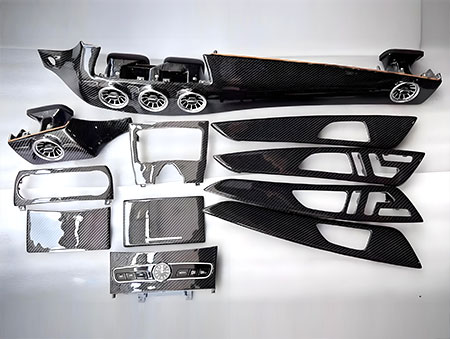
Holding traditional spare parts inventory costs about 20% till 55% of the part’s value every year.
Meltio (based in Spain) has a DED-based metal 3D printing and repair solution. They’ve successfully printed and repaired discontinued metal parts for automakers who are legally required to supply spares for 10+ years.
On the consumer side, consider this: a Lamborghini Murciélago owner refused to pay €20,000 (about $22,999) to replace two headlight assemblies. Instead, he used 3D scanning and FDM printing to replicate the headlight housings and related parts for just tens of euros in filament and a few hours of work. He saved over €20,000 on the spot. That’s a great example of “digital repair”—moving from replacing entire assemblies to fixing individual parts. The workflow (scan → model → print → install) shortens lead times and cuts warehousing costs.
7. Wrapping Up
Let’s recap:
LPBF exhaust valves with less porosity than cast ones. Porsche pistons, 10% lighter and +30 hp. Bugatti’s titanium caliper, 2 kg lighter. BLT’s door hinge, about 50% lättare. BMW’s roof bracket, 44% lighter and ten times stiffer. BYD’s U9X one-piece printed body, over 30% lighter and 200% stiffer in torsion. Ford printing aero parts trackside at the Nürburgring.
Every one of these numbers points to the same truth: 3D printing in auto parts isn’t about making cheaper parts. It’s about making parts that are impossible to make any other way. Parts with topology-optimized lattices. Parts that combine multiple functions into one. Parts made on demand, not for a warehouse.
Of course, 3D printing won’t replace stamping, casting, and forging across the whole auto industry. That’s not the point. The real path forward is a smart mix: additive manufacturing complements traditional methods in areas where lightweighting, customization, and supply chain flexibility matter most. As materials get better, print speeds go up, and certification processes mature, 3D printing will keep reshaping how we make auto parts. And we’re just getting started.
We are a professional 3D printing source factory with dozens of industrial SLM metal 3D printers and CNC machines, which are for post-processing to enhance the precision of 3D printed parts.
Please contact us, and there is special offer for new customers.

Legal Disclaimer:
1. We (DT, also called “DT 3D Print”) are an independent aftermarket manufacturer. All products are custom 3D printed, non-OEM parts.
2. We are not affiliated with, endorsed by, or officially connected to Porsche, Audi, BMW, Toyota, GM, or any other vehicle manufacturer.
3. All brand names, model names, and vehicle platform references are used exclusively for fitment and compatibility description purposes only.