

1. 시작하며
자동차 제조사들은 더 이상 3D 프린팅을 시제품 및 금형 제작에만 국한하여 사용하지 않습니다.
현재 3D 프린팅을 활용하여 실제, 생산용 부품: 엔진 구성품, 섀시 구조, 브레이크 시스템, 본문 프레임, 그리고 서비스용 예비 부품까지.

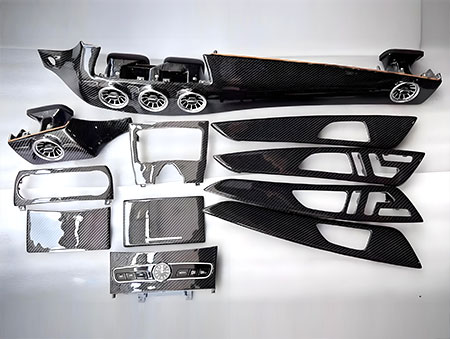
이는 3D 프린팅이 CNC와 같은 기존 생산 방식에 비해 많은 장점을 가지고 있기 때문입니다., 아래 그림과 같이.

이 기사는 엔진 부품부터 차체 패널에 이르기까지, 3D 프린팅 자동차 부품의 실제 적용 사례를 상세히 안내합니다., 브레이크, 레이싱 장비, 및 교체 부품. 이 과정에서 실제 사례와 수치를 소개해 드리겠습니다..
2. 엔진 핵심 부품: 배기 밸브에서 실린더 헤드까지
2.1 3D 프린팅 배기 밸브: LPBF, 기존 캐스팅 방식을 뛰어넘다
배기 밸브는 해결하기 까다로운 문제입니다. 이는 내연 기관 내부에 위치해 있습니다, 폭염 대처법, 고압적, 그리고 끊임없는 순환. ~에서 2026 Springer에서 발간된 연구, 연구진은 레이저 파우더 베드 융합 방식을 비교했다 (LPBF) 디젤 엔진 배기 밸브 제작을 위한 기존 주조 방식에 반하여.
그들은 인코넬 718 배기 밸브 전체 인쇄, 그 후 마이크로 CT 스캔을 통해 다공성과 표면 거칠기를 측정했습니다. 결과? LPBF 부품은 측정된 모든 지점에서 표면 거칠기가 훨씬 더 낮았습니다.. SEM 이미지는 좁은, 주조 밸브 헤드에 깊은 마모 자국, 반면 LPBF 제품들은 마모 흔적이 거의 없었습니다. CT 스캔 결과, LPBF 부품의 기공률이 훨씬 낮은 것으로 확인되었습니다., 이는 피로 강도와 신뢰성이 더 우수함을 의미합니다.
핵심 요점: 엔진 내 가장 혹독한 조건에 노출된 부품조차도, 33D 프린팅은 “단순히 시제품 제작용”에서 “실제로 성능을 향상시키는” 기술로 발전했습니다.
2.2 3D 프린팅 피스톤: 10% 더 가볍게, +30 HP
고성능 엔진에서는, 피스톤의 무게는 스로틀 반응과 출력 성능에 직접적인 영향을 미칩니다..
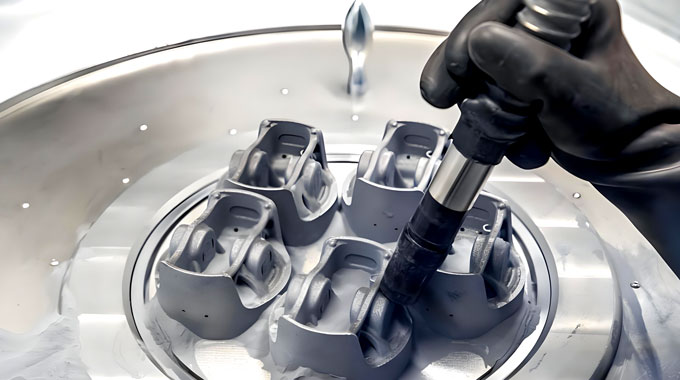
포르쉐는 자사의 피스톤을 통해 진정한 혁신을 이뤄냈습니다. 911 GT2 RS. 레이저 금속 융합 기술 활용 (LMF) 및 고순도 금속 분말, 그들은 다음과 같은 피스톤을 3D 프린팅으로 제작했습니다. 10% 라이터를 켜고 30 더 높은 마력. 3D 프린팅 공정을 통해 피스톤 내부에 직접 냉각 채널을 형성할 수 있었는데, 이는 기존 제조 방식으로는 도저히 불가능한 일이었습니다.. 이로 인해 연소 효율과 열 관리가 획기적으로 개선되었습니다..
더 넓은 관점에서 보면, 티타늄 합금 피스톤에 대한 연구 결과에서도 유사한 이점이 나타났습니다. 토폴로지 최적화 및 3D 프린팅을 통해, 티타늄 피스톤 / 왕복 운동 질량, 엔진 반응성 향상 및 연비 개선.
2.3 3D 프린팅 GT3 실린더 헤드: 168 연속 인쇄 가능 시간
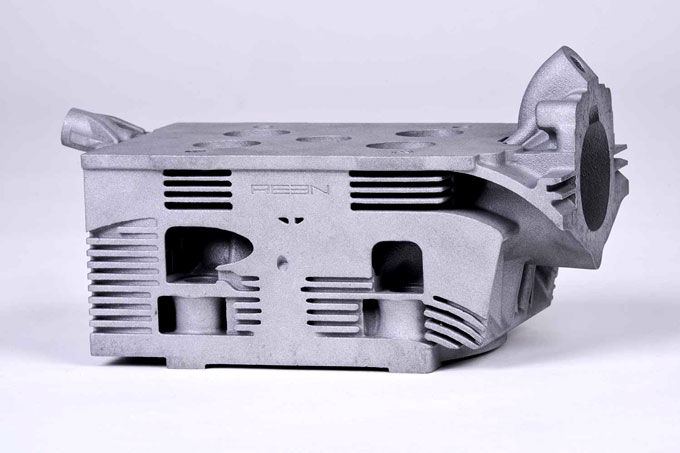
1월에 2026, BÖLLINGER GROUP과 REEN이 세계 최초로 3D 프린팅으로 제작된 공랭식 GT3 스타일 실린더 헤드를 공개했습니다.. 그들은 알루미늄 분말을 사용하여 연속 금속 적층 공정을 전체 기간 동안 진행했으며, 168 시간, 복잡한 내부 냉각 채널이 있는 실린더 헤드 조립. 해당 채널들의 형태와 레이아웃을 전통적인 방식으로 구현하는 것은 거의 불가능할 것입니다.. 3D 프린팅 후, 그들은 그것을 다음과 같이 마무리했습니다. 고정밀 CNC 가공 그리고 극한 조건에서도 문제없이 작동할 수 있는지 품질 검사를 실시했습니다.
168시간에 걸친 인쇄 과정과 최종 성과는 고부가가치, 고성능 엔진 부품, 33D 프린팅은 “멋진 시연”에서 “실용적인 생산 도구”로 진화하고 있습니다.
2.4 엔진 블록용 모래 프린팅: 캐스팅을 위한 디지털 업그레이드
당사는 엔진 블록을 직접 인쇄하지 않습니다. (아직은 아니지만), 하지만 3D 프린팅은 주조 방식, 특히 모래 주형을 사용하는 방식을 변화시키고 있습니다..
A 2025 한 연구에서 바인더 제팅 기술을 활용해 엔진 블록용 모래 코어를 인쇄한 결과 실질적인 성과를 거두었습니다.. 세 가지 핵심 요소가 결국 42%, 37%, 그리고 51% lighter, 여러 가지 복잡한 기능을 하나의 핵심 기능으로 통합하면서.
3D 프린팅 모래 코어의 아름다움? 초안 각도는 필요 없습니다.. 즉, 엔지니어들은 순전히 성능과 열 효율만을 고려하여 설계할 수 있습니다., 해당 부품이 실제로 주조될 수 있는지 여부에 대해서는 걱정하지 말고.
3. 섀시 & 브레이크 부품: 체중 감량이 정말 중요한 곳
3.1 3D 프린팅으로 제작된 부가티의 티타늄 브레이크 캘리퍼: 위로 40% 더 가볍게
브레이크 캘리퍼는 섀시 부품 분야에서 3D 프린팅이 이룬 가장 대표적인 성공 사례 중 하나입니다..
지난 1월 2018, 부가티는 치론(Chiron)을 위해 세계 최초로 3D 프린팅 방식으로 제작된 티타늄 8피스톤 모노블록 브레이크 캘리퍼를 출시했습니다.. 그것은 ~를 측정합니다 41 cm 길이, 21 cm 너비, 그리고 13.6 cm 높이, 무게는 고작 2.9 kg. 키론의 알루미늄 캘리퍼와 비교했을 때 (4.9 kg), 그건 2 kg 하락—보다 더 40% lighter. 그리고 티타늄 캘리퍼는 사실 알루미늄보다 더 튼튼합니다.. 더 가볍으면서도 더 튼튼합니다.
캘리퍼스 1개를 인쇄하는 데는 약 45 시간, 그리고 또 하나 11 CNC 정밀 가공 시간, 총 약 56 시간. 벽 두께는 1 로 4 mm.
부가티는 당시 이 부품이 세계 최대 규모의 적층 제조 티타늄 기능성 부품이라고 밝혔습니다.. BLT는 이 분야에서도 수많은 성과를 거두었습니다.. 토폴로지 최적화 및 시뮬레이션 활용, 그들은 최대 스트레스 목표를 320 MPa. 최적화 후, 전륜 하중 감소 39.6%, 그리고 후륜 하중이 감소했습니다 48.8%. 캐스트 버전과 비교했을 때, 적층 제조된 티타늄 브레이크 캘리퍼의 무게는 30% 더 적게, 경도나 내열성을 저하시키지 않으면서.
3.2 3D 프린팅 서스펜션 너클: 36.1% 그리고 32.8% 무게 절감
서스펜션 너클은 사방에서 가해지는 하중을 받습니다. 포뮬러 스튜던트 팀을 위해, BLT는 PBF-LB/M 기계를 사용하여 고강도 알루미늄으로 앞뒤 너클을 제작했습니다.. 이 프린트 처리된 너클은 서스펜션에 간섭 없이 완벽하게 장착됩니다.. 기존의 CNC 가공과 비교했을 때, 앞쪽 손가락 마디의 무게는 36.1% 더 적게, 그리고 뒤쪽 것 32.8% 더 적게.
산환 단조(Sanhuan Forging)는 전기차용 스티어링 너클 제작에도 참여했습니다.. 적층 제조 활용, 이 회사는 경쟁사 대비 5%~10%의 무게 우위를 확보했으며, 제품 개발 기간을 20%. 이 회사의 손가락 관절과 팔을 일체형으로 설계한 제품은 중국 특허 우수상을 수상했습니다..
맥라렌의 W1 슈퍼카, ~년 말에 출시되었습니다 2024, 3D 프린팅으로 제작된 티타늄 프론트 너클과 서스펜션 암을 사용합니다. W1의 무게는 불과 1,399 kg 및 팩 단위는 1,200 마력. 이 믿기 힘든 출력 대 중량 비율은 적층 가공으로 제작된 서스펜션 부품 덕분이 큽니다..
3.3 3D 프린팅 티타늄 도어 경첩: 소개 50% 더 가볍게
다음과 같이 2025 Formnext 전시회, BLT는 자사 제품인 BLT-S-Ti64 분말로 제작된 일체형 티타늄 도어 경첩을 선보였습니다.. 기존의 주조 알루미늄 또는 단조 강철 경첩과 비교했을 때, 이 제품은 기존과 동일한 강도와 신뢰성을 유지하면서도 무게를 대략 50%. 이는 비탄성 질량과 전반적인 효율성 측면에서 진정한 성과입니다..
3.4 후륜 차축 캐리어: 중공 격자 설계의 획기적인 발전
For large EV structural parts, BLT demonstrated a one-piece 3D printed rear axle carrier. The design uses a hollow structure with just 2 mm thick walls, filled with internal lattices to optimize force paths. Total weight is about 20% lighter than traditional cast or welded designs, while still meeting all strength and stiffness requirements.
4. Car Body Structures: From Trim Parts to Load-Bearing Components
4.1 BMW i8 Roof Bracket: A Milestone for Production Metal 3D Printing
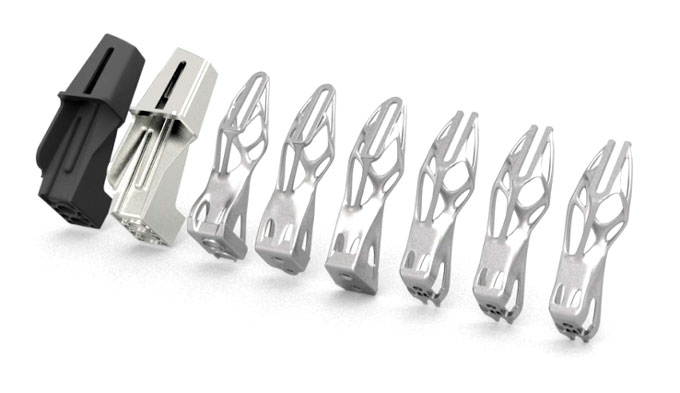
In 2018, BMW won an Altair Enlighten Award for a 3D printed metal convertible roof bracket used in the i8 Roadster. It was the world’s first metal 3D printed part in a mass-production passenger car. BMW’s metal additive manufacturing head, Maximilian Meixlsperger, had spent ten years designing within traditional manufacturing limits. But with selective laser melting (SLM), the design-to-production cycle dropped to just three months. The bracket uses a load-path design from topology optimization, cutting weight by 44% while increasing stiffness tenfold. And they could print over 600 of them in a single batch. Even better: no supports needed during printing, so post-processing was minimal.
4.2 BYD Yangwang U9X: World’s First 3D Printed High-Performance Body Structure
In October 2025, BYD showed off the Yangwang U9X’s integrated 3D printed body structure at the EuroCarBody 2025 conference. It’s a world first. Using BLT’s metal printing, they designed hollow chambers and rib structures inside the body. Compared to a solid part of the same weight, torsional stiffness went up by more than 200%. And the high-strength aluminum structure cut overall vehicle weight by over 30%. On key body parts, more than 90% of printed surfaces stayed within ±0.5 mm of spec.
The U9X set a production car speed record of 496.22 km/h at Germany’s ATP test track, and ran the Nürburgring Nordschleife in 6:59.157—two world records. BLT also supplied 20 3D printed high-performance brake calipers for the U9X, all of which passed endurance testing at the Ring. Thanks to topology optimization, those calipers are 20%–30% lighter, with internal fluid channels and inserts printed right in.
4.3 Cadillac CELESTIQ: 위로 130 3D Printed Parts
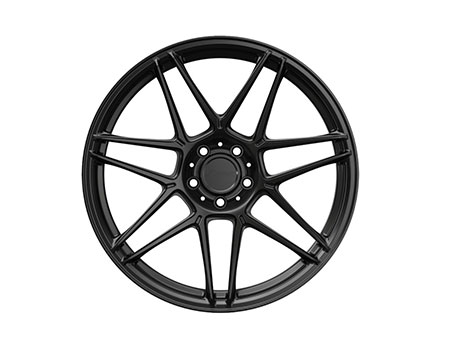
GM’s Cadillac CELESTIQ ultraluxury electric sedan shows how far additive can go in a production vehicle. It has more than 130 3D printed parts—the most of any GM model ever. These include a steering wheel center trim piece (GM’s largest production metal 3D printed part to date), a seatbelt adjustment guide ring (GM’s first 3D printed metal safety part, which won an award from the Metal Powder Industries Federation), plus window switches, armrests, and interior trim. All of them were developed at GM’s Additive Industrialization Center (AIC) in Warren, Michigan, a 15,000 sq ft facility with over 20 polymer and metal printers.
5. Racing & Extreme-Duty Parts: Where Design Freedom Proves Itself
Racing is the ultimate testing ground for 3D printed parts. 왜? Because when you’re chasing every gram of weight loss and every tenth of a second, cost is no object. That’s where design freedom really shines.
Ford showed this with the Mustang GTD project in 2025. Engineers at the Nürburgring printed new aero parts right at the track, on the fly. The Mustang GTD ended up lapping the Nordschleife in 6:52, beating Ferrari and others. That kind of “print, test, iterate in days” workflow is something traditional manufacturing simply can’t do.
On the thermal management side, Conflux Technology has built heat exchangers with hundreds of thousands of tiny fin features, with walls as thin as 300 microns. A single pinhole leak would trash the whole part. Conflux’s additively made heat exchangers have passed full endurance tests, delivering way better heat transfer in a super compact, lightweight package. Founder Michael Fuller points out that 3D printing lets them quickly iterate on complex parts like brake ducts—parts that would normally need 60 로 80 molds—giving race teams extra aero testing time and real lap time gains.
6. Spare Parts & 수리: Digital Inventory in Action
Holding traditional spare parts inventory costs about 20% 로 55% of the part’s value every year.
Meltio (based in Spain) has a DED-based metal 3D printing and repair solution. They’ve successfully printed and repaired discontinued metal parts for automakers who are legally required to supply spares for 10+ 년.
On the consumer side, consider this: a Lamborghini Murciélago owner refused to pay €20,000 (about $22,999) to replace two headlight assemblies. Instead, he used 3D scanning and FDM printing to replicate the headlight housings and related parts for just tens of euros in filament and a few hours of work. He saved over €20,000 on the spot. That’s a great example of “digital repair”—moving from replacing entire assemblies to fixing individual parts. The workflow (scan → model → print → install) shortens lead times and cuts warehousing costs.
7. Wrapping Up
Let’s recap:
LPBF exhaust valves with less porosity than cast ones. Porsche pistons, 10% lighter and +30 hp. Bugatti’s titanium caliper, 2 kg lighter. BLT’s door hinge, about 50% lighter. BMW’s roof bracket, 44% lighter and ten times stiffer. BYD’s U9X one-piece printed body, over 30% lighter and 200% stiffer in torsion. Ford printing aero parts trackside at the Nürburgring.
Every one of these numbers points to the same truth: 3D printing in auto parts isn’t about making cheaper parts. It’s about making parts that are impossible to make any other way. Parts with topology-optimized lattices. Parts that combine multiple functions into one. Parts made on demand, not for a warehouse.
물론입니다, 3D printing won’t replace stamping, 캐스팅, and forging across the whole auto industry. That’s not the point. The real path forward is a smart mix: additive manufacturing complements traditional methods in areas where lightweighting, customization, and supply chain flexibility matter most. As materials get better, print speeds go up, and certification processes mature, 3D printing will keep reshaping how we make auto parts. And we’re just getting started.
We are a professional 3D printing source factory with dozens of industrial SLM metal 3D printers and CNC machines, which are for post-processing to enhance the precision of 3D printed parts.
Please contact us, and there is special offer for new customers.

Legal Disclaimer:
1. We (DT, also called “DT 3D Print”) are an independent aftermarket manufacturer. All products are custom 3D printed, non-OEM parts.
2. We are not affiliated with, endorsed by, or officially connected to Porsche, Audi, BMW, Toyota, GM, or any other vehicle manufacturer.
3. All brand names, model names, and vehicle platform references are used exclusively for fitment and compatibility description purposes only.