

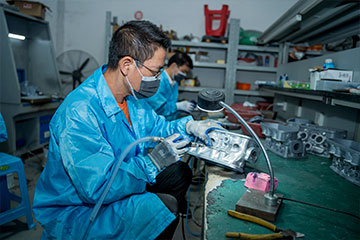
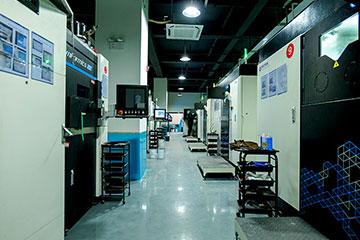

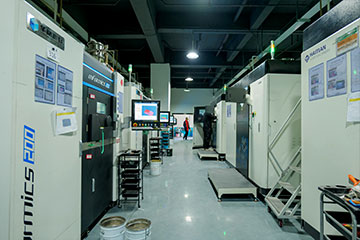
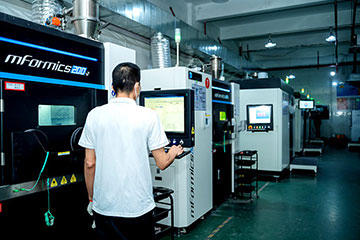
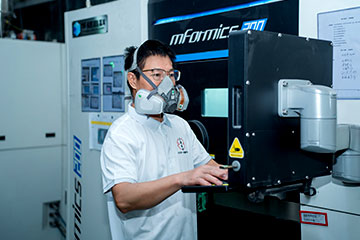
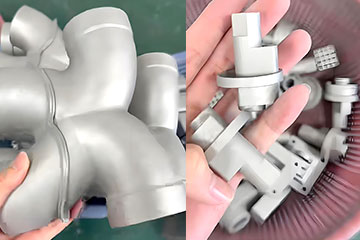
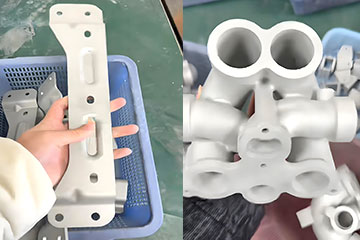
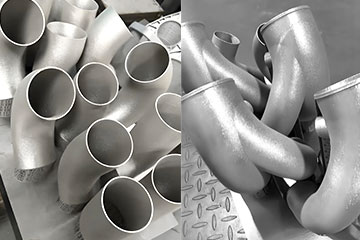
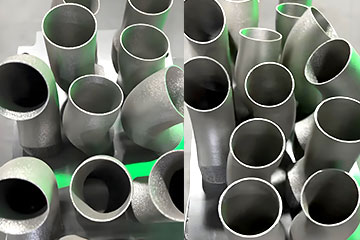
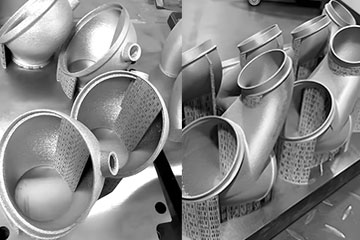
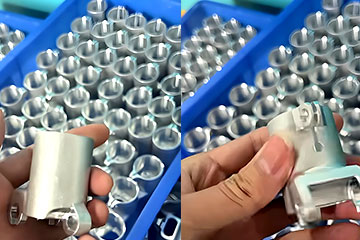
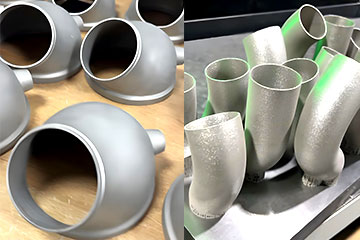
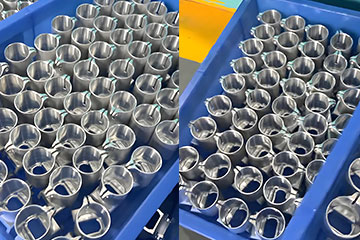
In addition to our core metal 3D printing service, plastic & resin 3D printing service, and CNC Machining service , we offer an extensive portfolio of complementary post-processing services for 3D printed parts, including:
1.1 Secondary Machining
CNC finish machining
We perform secondary CNC machining on 3D printed blanks to hit tight dimensional tolerances and refine fine details.
Wire EDM (Included by default)
Wire electrical discharge machining to cut hard metal printed components away from the build plate.
Support removal (Included by default)
Manual or mechanical removal of support structures created during metal additive manufacturing.
1.2 Surface Finishing
Deburring
Removes sharp edges and burrs left behind after 3D printing or machining operations.
Sandblasting
Propels abrasive media at the part surface to create a consistent matte metal finish.
Shot peening
Small spherical media bombards the workpiece, introducing compressive surface stress to increase fatigue life.
Polishing
Surface finishing to smooth metal workpieces and produce reflective or semi-reflective surfaces.
Electropolishing
An electrochemical process that removes microscopic surface peaks. It delivers ultra-smooth surfaces and improves fatigue resistance for stainless steel and titanium parts.
Magnetic Polishing (Magnetic Abrasive Finishing, MAF)
Uses a magnetic field to move abrasive media, polishing complex internal cavities and hard-to-reach features on metal 3D printed parts.
Laser Polishing
Controlled laser energy re-melts a thin surface layer of printed metal, reducing layer lines and lowering surface roughness.
Abrasive Flow Machining (AFM)
Forces a thick, abrasive-laden polymer medium through internal channels to smooth intricate internal passages on additive manufactured parts.
1.3 Conversion Coatings & Coatings
Anodizing
Electrochemical treatment for aluminum parts that builds a protective oxide layer, improving corrosion resistance and wear performance.
Black oxide
A conversion coating for steel alloys. It provides modest corrosion protection and a uniform matte black finish with almost no dimensional shift.
Electroplating
Deposits a thin metal layer such as nickel, chrome, copper or gold onto parts to boost wear resistance, corrosion protection and electrical conductivity.
Electroless plating
A plating process that requires no external electric current. It deposits consistent nickel coatings even on complex internal geometries for reliable corrosion resistance.
Powder coating
Dry powder is applied then heat-cured to form a tough, long-lasting colored protective coating on metal parts.
Wet painting / Liquid coating
Liquid paint is sprayed and cured to deliver custom colors, cosmetic appearance and corrosion protection.
PVD coating (Physical Vapor Deposition)
Vacuum-based process applying ultra-thin hard ceramic or metal films. These coatings offer excellent wear resistance, low friction and decorative color options.
1.4 Material Property Modification
Heat treatment
Controlled heating and cooling cycles to alter metal mechanical properties such as hardness and toughness.
HIP (Hot Isostatic Pressing)
Combines high temperature and high pressure to close internal porosity within 3D printed metal parts and raise material density.