

Let’s be real: 3D printing isn’t just for prototypes anymore
Here’s something you may or may not know about the automotive industry: 3D printing — or additive manufacturing, if you want to get technical — is slowly but surely moving from the sidelines to center stage.
Right now, 3D printing in the auto world boils down to three main use cases:
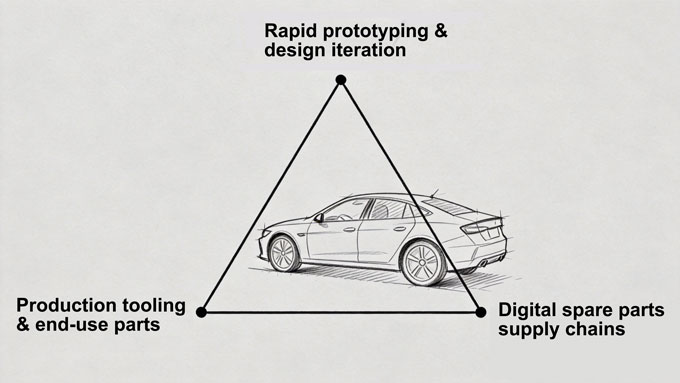
- Rapid prototyping and design iteration
- Production tooling and end-use parts
- Digital spare parts supply chains
Let’s dive into each one. I’ve got real-world examples, hard numbers, and some pretty wild stories to back it all up.
From CAD to the racetrack in hours (not months)
Here’s the thing about traditional car development: making a prototype part used to take weeks. Sometimes months.
You’d have to cut tooling, wait for molds, cross your fingers, and hope it worked.
3D-печать? It completely flips that script.
Case study: Ford Mustang GTD 3D Printing “hood flicks”
В 2025, the Ford Mustang GTD ripped a 6:52.072 lap around the Nürburgring — making it the first American production car to break the 7-minute barrier. Then in April 2026, the even more hardcore Mustang GTD Competition version shaved off another 11 seconds with a 6:40.835 lap.
So what’s the secret sauce?
3D-печать.
Here’s the backstory: Ford’s engineers noticed that at speeds north of 300 km/h, the Mustang GTD’s front end was getting a little floaty. Not ideal when you’re trying to set lap records.
The traditional fix? Cut metal molds, rework stampings, wait months. Not gonna cut it when you’re literally at the track trying to shave seconds.
So Greg Goodall, the Mustang GTD’s Chief Program Engineer, made a call: deploy a 3D printer at the track.
His team designed these tiny little aero parts called “hood flicks” — basically small raised pieces that sit around the hood vents. They subtly reshape airflow to add front-end downforce without increasing drag.
Here’s where it gets good: after each wind tunnel test, the engineers would tweak the design, print a new version right there on-site, and slap it on the car for the next run.
Seven or eight design iterations. About 20 coefficient drag tests. All compressed into days instead of months.
That’s the power of “design-print-test” on the fly. And it’s exactly why the Mustang GTD is now one of the fastest production cars on the planet.
From prototypes to production lines
If rapid prototyping is 3D printing’s comfort zone, then 3D printing actual production parts for actual cars is where things get really interesting.
Case study: BMW with 35 years in the 3D Printing, WAAM is finally here
BMW has been messing around with 3D printing since1990. That’s right — three and a half decades.
At first, it was just for concept cars and prototypes. But today? 3D-printed parts are inevery single BMW Group brand — MINI, BMW, Rolls-Royce, and BMW Motorcycles. And they’re in every factory the company operates worldwide.
But here’s what I find most exciting: WAAM (Wire Arc Additive Manufacturing).
Think of it as 3D printing on steroids. WAAM uses an electric arc to melt metal wire — kind of like welding, but controlled by software that builds up layer after layer until you have a complete part.
The big advantage? You can printmassive, single-piece structural components that would normally require multiple parts bolted or welded together.
BMW started developing WAAM in 2024, began vehicle-level testing in 2025, and is targeting2027 for full series production.
This is a big deal. We’re talking about industrial-scale additive manufacturing becoming a reality in the auto industry.
Case study: BYD Yangwang U9X — the world’s first 3D-printed production body
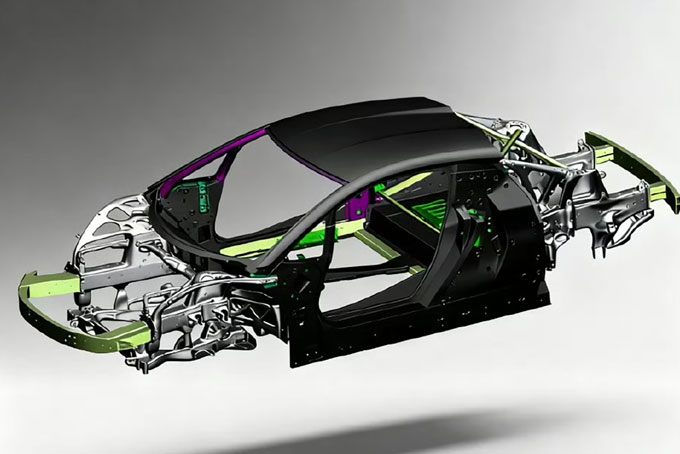
At the EuroCarBody 2025 conference, BYD dropped a bombshell: the world’s first integrated 3D-printed high-performance car body. And it wasn’t just for show — it tooktop score from the professional jury.
Here’s what makes it impressive:
BYD used metal 3D printing (laser powder bed fusion, to be specific) to build a high-strength aluminum alloy body structure. Through topology optimization — which is a fancy way of saying “let the computer figure out where the material actually needs to go” — they achieved a200% increase in torsional stiffness compared to a solid structure of the same weight.
Oh, and they also cutнаверх 30% of the weight compared to traditional manufacturing.
Precision? Наверх 90% of the printed surfaces held dimensional deviation within±0.5 mm.
But wait — there’s more. BYD also printed20 sets of brake calipers for the U9X. Through topology optimization, they shaved off 20–30% of the weight and integrated the oil channels and inserts directly into the print. Fewer assembly steps, better reliability under extreme conditions.
Case study: Karsan 3D printing— 80% cost reduction on bus parts
Here’s a story that hits close to home for anyone in manufacturing.
Karsan, a Turkish electric bus manufacturer, had a problem. They needed to cut weight to meet strict EU regulations, but traditional injection molding was way too expensive for low-volume custom parts. And outsourcing sheet metal fabrication? Too slow.
Their solution: bring a Stratasys F770 large-format FDM 3D printer in-house-.
The results?
Cost per part dropped from€2,500 to €500 — that’s an80% сокращение
Production lead time slashed by3 к 4 недели.
That’s not a small improvement. That’s a game-changer for low-volume manufacturing.
Cases: More automakers getting in on the action
Volkswagen announced back in 2021 that it plans to produceдо 100,000 3D-printed parts per year at its Wolfsburg plant by 2025 — using binder jetting for structural parts like A-pillars.
General Motors completed over 5,400 additive manufacturing projects in 2024. The Cadillac CELESTIQ alone packsmore than 130 3D-printed components — including GM’s largest production metal 3D-printed part to date (a steering wheel trim bezel).
Toyota is pushing 3D printing from the design lab to the factory floor. They’ve partnered with Stratasys to cut tooling lead times down to a single day and developed the world’s largest near-solid 3D-printed die-cast mold insert (156 kg).
Ford is combining AI with 3D printing at its Kentucky Truck Plant for tooling and quality control.
The supply chain revolution Автор 3D-печать nobody’s talking about
Here’s something that doesn’t get enough attention: 3D printing isn’t just changing how we make parts. It’s changing where and when we make them.
The old model? Stockpile decades’ worth of spare parts in warehouses. Hope you guessed right on demand. Pray nothing gets discontinued.
The new model? Digital inventory.
Instead of storing physical parts, you store digital files. Need a part? Print it on demand. Right when you need it. Right where you need it.
Пример из практики: BMW’s decentralized 3D printing network
BMW is already doing this at scale.
At their additive manufacturing campus in Germany, they’re recycling waste powder into filament and pellets for 3D printing tools and fixtures-.
At the Munich plant, they’re using 3D-printed temporary positioning parts to precisely align steering linkages during chassis assembly. Once the job’s done, the parts come off and get reused.
The kicker? This decentralized network can deliver partsin hours, not days.
That’s the kind of supply chain agility that used to be pure fantasy.
Where things are headed
Look back at the trajectory and you’ll see a clear pattern:
Then: concept models and prototypes
Now: production tooling and end-use parts
Далее: fully integrated, multi-material, large-scale production
3D printing started at the edges. Now it’s moving to the core.
And the drivers? They’re only getting stronger:
Electric vehicles need lightweight parts to maximize range
Supply chain disruptions have everyone rethinking just-in-time inventory
Customers want customization and personalization
All of these trends play directly into 3D printing’s strengths.
The bottom line? If you’re in automotive manufacturing and you’re not paying attention to additive manufacturing, you’re already behind.